ZeroBounce vs Bouncer: Which Email Verifier Wins in 2026?
 BounceCheck Team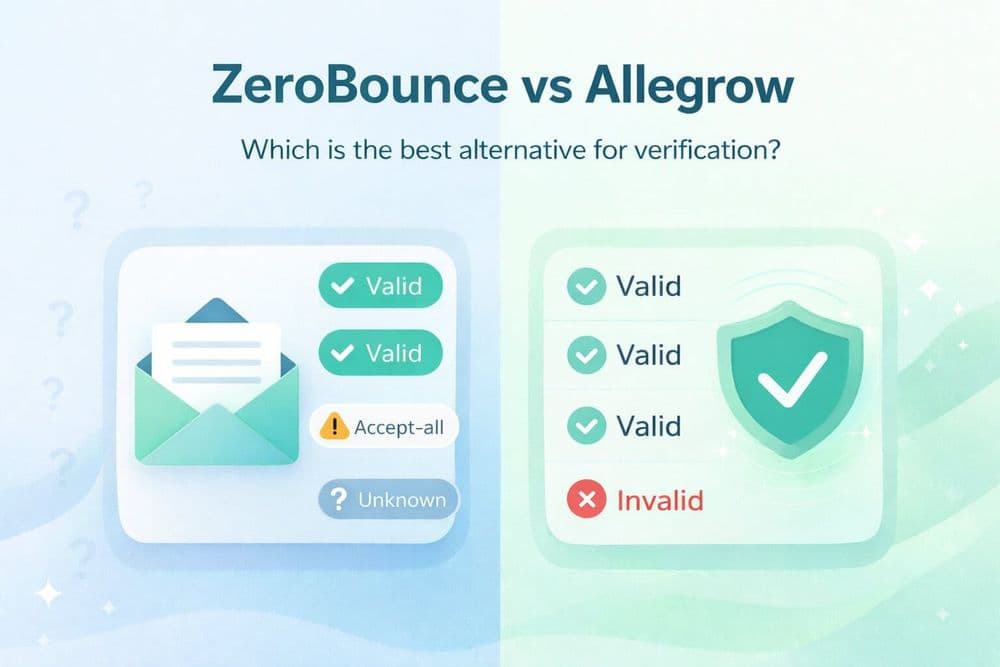
Before your next send Find the addresses that will bounce.
Verify an email freeYou are picking between two of the most-cited names in email verification. ZeroBounce is the older, feature-heavy incumbent (claimed 99.6% accuracy, full deliverability toolkit, PAYG or subscription pricing). Bouncer is the leaner, cheaper challenger (99.5% accuracy, around $150 for 100,000 verifications versus ZeroBounce's $425).
The short version:
- Pick ZeroBounce if you want the broadest feature set (AI scoring, blacklist monitoring, email finder, inbox placement testing) and you will actually use the wider toolkit.
- Pick Bouncer if you want simpler, faster, and roughly 50% cheaper at every published volume tier above 10k, with non-expiring pay-as-you-go credits.
- If you want pay-as-you-go pricing at $0.001 per email and a stealth SMTP engine, BounceCheck is the third option worth running through your test list before you commit.
Why people switch between ZeroBounce and Bouncer
Most teams comparing these two are doing one of three things:
- Coming off a free or trial plan and looking at real volume costs.
- Assuming ZeroBounce requires a $99/month ZeroBounce ONE subscription, when pay-as-you-go credits are available without one.
- Looking at Bouncer for the price gap, but worried about feature parity.
The pain points show up in predictable spots. ZeroBounce ONE is a monthly subscription plan, and unused credits roll over as long as the subscription stays active. Bouncer's pay-as-you-go credits never expire regardless of subscription status, so seasonal senders are not paying for unused volume. On a million-email cleanup, Bouncer's published comparison puts ZeroBounce at $2,750 and Bouncer at $750. Even on a 100,000-email list, the gap is roughly $275.
ZeroBounce vs Bouncer: side-by-side
| Feature | ZeroBounce | Bouncer |
|---|---|---|
| Claimed accuracy | 99.6% | 99.5% |
| Free credits | 100/mo (free business-domain account) | 100 on signup |
| Entry plan | PAYG from $0.0085/email, or $99/mo ZeroBounce ONE (10k credits, optional) | Pay-as-you-go from ~$8 per 1k |
| 100,000 verifications | ~$425 | ~$150 |
| 1,000,000 verifications | ~$2,750 | ~$750 |
| Credits expire | No, while ONE subscription is active | No (PAYG never expires) |
| GDPR | Compliant | Compliant by design |
| Throughput | Up to 200k/hour | Up to 180k/hour |
| Catch-all detection | Yes | Yes |
| Disposable detection | Yes | Yes |
| Deliverability extras | Blacklist monitor, inbox placement, AI scoring, email finder | Bouncer Shield, Deliverability Kit |
| Best for | Teams wanting one full deliverability suite | Cost-conscious senders and SaaS dev teams |
Numbers cross-checked against Bouncer's full platform comparison and ZeroBounce's published pricing.
ZeroBounce: strengths and weaknesses
Strengths
- Largest feature surface area of the major verifiers. AI scoring, abuse email detection, spam trap database, blacklist monitor, email finder, inbox placement testing, all under one login.
- Long track record. ZeroBounce has been operating for years and processes billions of verifications, which matters for SMTP catch-all reliability.
- Strong compliance posture (GDPR, plus enterprise-tier certifications on request).
- Well-known on G2 with hundreds of reviews to cross-reference.
Weaknesses
- Pricing can add up at scale. ZeroBounce ONE starts at $99/month for 10,000 credits ($79/month if billed annually), though a subscription is optional. Pay-as-you-go is $0.0085 per email at low volume, dropping at scale.
- The dashboard feels older than its competitors. Functional, but not polished.
- Smaller free tier than some challengers if you are testing casually before committing to a plan.
Best for: Mid-size senders who want one tool that covers verification plus deliverability monitoring, and who actually use the wider toolkit.
Bouncer: strengths and weaknesses
Strengths
- Roughly 50% cheaper than ZeroBounce at every published volume tier above 10,000 verifications.
- Pay-as-you-go credits never expire. You buy what you need.
- GDPR compliant by design (data anonymized at rest, EU-based processing).
- Bouncer Shield blocks invalid signups in real time at the form level.
- Cleaner dashboard, faster onboarding, 24/7 personalized support.
Weaknesses
- Smaller feature surface. No standalone email finder or inbox placement product.
- Smaller G2 footprint than ZeroBounce, so less third-party review depth.
- Catch-all results are returned as "risky" rather than scored. You will want to sample-test before sending.
Best for: Cost-sensitive senders, SaaS teams who just need a clean API, and agencies cleaning client lists where the budget question keeps coming up.
How to choose between ZeroBounce and Bouncer
Use this short decision tree:
- Verification only, no extra toolkit needed? Bouncer wins on price and simplicity.
- Want one vendor for verification plus blacklist plus inbox placement plus AI scoring? ZeroBounce.
- Verifying in bursts (every 2 to 3 months)? Bouncer. Non-expiring PAYG credits matter, though ZeroBounce's own PAYG credits also don't require a subscription.
- Predictable monthly volume of 10k or more? ZeroBounce ONE pricing becomes more competitive.
- Developer-first SaaS team? Bouncer's API is leaner and faster to integrate. ZeroBounce works fine but the docs are heavier.
There is a third option many teams overlook: BounceCheck. It runs a 30-step verification engine with a stealth SMTP layer (verifies without notifying recipients), prices Starter at $9.99 for 10,000 credits ($0.001 per email, cheaper than Bouncer's PAYG and well under ZeroBounce ONE), and returns Valid, Risky, or Invalid plus a 0 to 100 confidence score. Honest gaps: BounceCheck is newer (founded 2021), has no public G2 page yet, monthly credits do not roll over, and standard tiers cap at 50,000. If you fit inside that envelope, it is worth a 1,000-email side-by-side test against either of the bigger names. If BounceCheck does not fit either, the wider field of bulk email verifiers is worth sampling before you commit.
Test before you commit
Don't over-index on the headline price. Run the same 1,000-email sample through ZeroBounce, Bouncer, and one challenger like BounceCheck. Look at three things:
- Agreement rate on Valid addresses. It should be above 95% across all three.
- Disagreement on Risky and Catch-all. This is where vendors actually diverge.
- False-positive rate on a known-good list of 100 addresses you control.
All three tools detect disposable domains, but if you want to spot-check a single suspicious address before adding it to a list, BounceCheck's free disposable email checker handles it without an account.
FAQs
Is ZeroBounce more accurate than Bouncer?
On vendor-claimed numbers, ZeroBounce states 99.6% accuracy and Bouncer claims 99.5%. Both sit in the top accuracy tier alongside the other top email bounce checker tools.
Is ZeroBounce a reputable company?
Yes. ZeroBounce has been operating for years, holds a strong G2 reputation, and is GDPR compliant. Reputation is one of its strongest cards.
How much does ZeroBounce cost vs Bouncer?
ZeroBounce offers pay-as-you-go pricing from $0.0085 per email at low volume with no subscription required, or ZeroBounce ONE at $99/month for 10,000 credits ($79/month annual) for teams that want a subscription plan. Bouncer starts around $8 for 1,000 credits PAYG, scaling to roughly $0.0015 per email at 100k and above. Bouncer is cheaper at every published tier above 10,000 verifications.
Do Bouncer credits expire?
No. Bouncer's pay-as-you-go credits do not expire. ZeroBounce ONE credits roll over as long as the subscription stays active and do not expire for existing customers; ZeroBounce PAYG credits do not require a subscription at all.
Are both GDPR compliant?
Yes. Bouncer markets itself as GDPR compliant by design with EU data handling. ZeroBounce is GDPR compliant and offers data processing agreements on request. If GDPR is mission-critical for you, see our email validation GDPR guide.
What is a good alternative to both?
BounceCheck is the closest peer on accuracy with friendlier pricing and a stealth SMTP engine. See the full breakdown in our roundup of 10 best ZeroBounce alternatives.
Which has a better free trial?
ZeroBounce gives 100 free credits per month to qualifying business-domain signups on a free account, no ZeroBounce ONE subscription required. Bouncer gives 100 credits on signup. BounceCheck gives 100 credits on signup plus 50 free per month thereafter. All three are enough to vet a tool before paying.
Final thoughts
ZeroBounce and Bouncer are both legitimate choices. The decision usually collapses to one question: are you paying for a verification tool, or a deliverability suite?
If it is verification only, Bouncer's pricing is hard to beat and the accuracy gap is too small to matter at most volumes. If you will actually use the AI scoring, blacklist monitor, and inbox placement testing, ZeroBounce earns the premium.
And if you want something faster, leaner, and around $0.001 per email without a subscription floor, BounceCheck is the third option worth putting in the same test sample. Start free, 100 verifications, no card required.
§ Before your next send
Find the addresses that will bounce
Verify a single address free, or upload a CSV — the free plan includes 50 checks a month, no card needed.

BounceCheck Team
The team behind BounceCheck - helping businesses verify emails and improve deliverability.