Best Cold Email Tools in 2026: 7 Platforms Worth Paying For
 BounceCheck Team
Before your next send Find the addresses that will bounce.
Verify an email freeThere are over 40 cold email tools on the market right now, and most comparison articles rank them loosely without ever explaining what "best" actually means. A solo founder sending 30 emails a week needs a different platform than an agency running 200,000 emails a month across 40 client accounts. Picking by feature checklist alone almost always ends in a stranded subscription.
This guide ranks the seven cold email tools that consistently come out on top in side-by-side testing, with the trade-offs that actually matter: deliverability infrastructure, AI sequencing quality, pricing per inbox, and how cleanly the tool fits a specific team profile. Skim the comparison table, jump to the deep dive that matches your use case, then sanity-check your choice against the criteria at the end.
What Separates a Great Cold Email Tool From a Generic One
Four areas decide whether a cold email tool earns its monthly fee or becomes a write-off after the trial:
- Automation and scheduling. Can the tool run a multi-step sequence with follow-ups, conditional logic, and reply detection without you babysitting it? Tools that need constant manual intervention are not actually saving time.
- Deliverability. Built-in email warm-up, sender rotation, and SPF/DKIM/DMARC setup matter more than any other feature. A tool that lands in spam is useless regardless of how slick its UI looks.
- Analytics depth. Beyond bounce and open rates, does it give you per-step metrics, A/B test winners, and reply patterns? Without that detail, you cannot optimize.
- Integrations. Native sync with Salesforce, HubSpot, Pipedrive, and lead-enrichment platforms determines whether the tool slots into an existing stack or becomes a parallel silo.
Methodology note: the picks below are drawn from independently published reviews on Zapier, Hunter, EmailTooltester, and Saleshandy, cross-referenced against G2/Capterra ratings and operator feedback. No vendor in this list paid for placement.
Quick Comparison: Prices, Free Trials, and Best Fit

| Tool | Starting price | Free trial / plan | Best for |
|---|---|---|---|
| Hunter Sequences | $49/month | Free plan | Beginners and in-house teams |
| Saleshandy | $36/month | 7-day trial | High-volume agencies |
| Instantly | $47/month | 14-day trial | Scaling on unlimited inboxes |
| Smartlead | $39/month | 14-day trial | Deliverability-focused agencies |
| Apollo | $59/user/month | Forever-free plan | All-in-one lead gen + outreach |
| Lemlist | $59 to $79/month | 14-day trial | Visual personalization |
| Woodpecker | $29/month | 7-day trial | Small teams and solo senders |
| GMass | $25/user/month | 7-day trial | Gmail-native users |
Prices are entry-tier where unlimited inboxes are not included, or the cheapest plan where they are. Higher tiers add volume, AI credits, and lead-database access.
The 7 Best Cold Email Tools, Reviewed
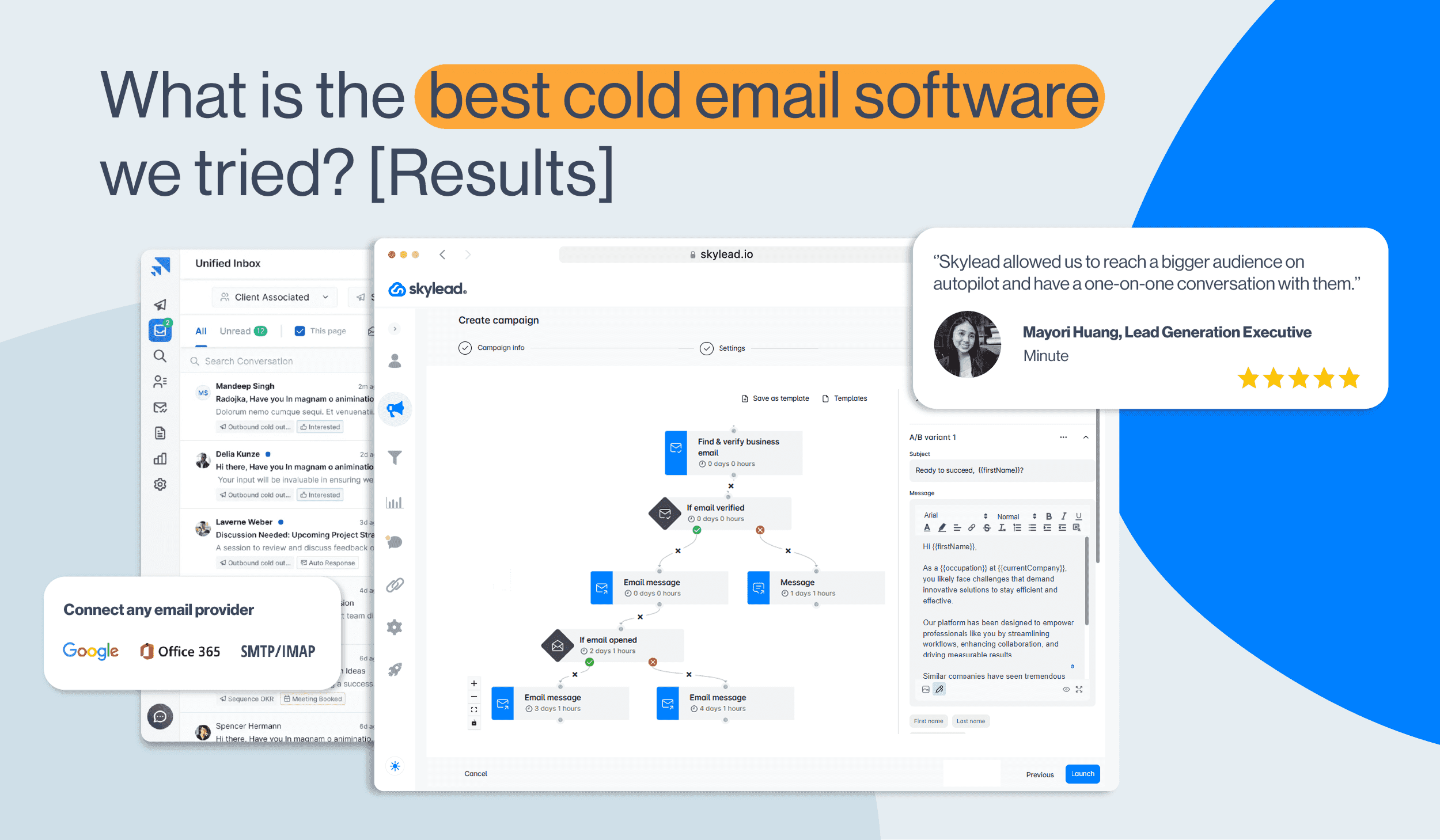
Each review below summarizes what the tool does well, where it falls short, and the team profile it actually fits.
1. Hunter Sequences, best for beginners and in-house teams
Hunter built Sequences in 2019 as a complement to its email-finder and verifier products, and it is the strongest pick if you want to find contacts, verify them, and run sequences inside one workflow. The free plan supports a real 500-recipient campaign with open tracking, personalization, up to 5 follow-up steps, and access to 200+ templates, more than enough to run actual outreach (not just a demo). Paid plans add A/B testing, where Hunter automatically splits recipients between variants and surfaces the winner in your reporting.
The newest standout is the in-platform domain purchase: you can buy a sending domain inside Hunter with SPF, DKIM, and DMARC pre-configured, then run progressive Inbox Protection warm-up before your first send. Paid plans start at $49/month with unlimited team members.
Best for: SMBs, freelancers, and in-house teams who want quality over volume. Watch out for: capped at 20 sending inboxes even on the $499/month Business plan, so high-volume agencies will outgrow it.
2. Saleshandy, best for high-volume agencies
Saleshandy is the most agency-friendly tool on the list. All paid plans (from $36/month) include unlimited email accounts and unlimited team members, plus unlimited warm-up via its sister product TrulyInbox. Sender rotation and a built-in email verifier are bundled rather than sold as add-ons.
The AI Sequence CoPilot takes a website URL plus a prospect list and outputs full sequences with subject lines and personalized opening lines, generally a solid first draft you can fine-tune to brand voice. Saleshandy's Content Guide scores your email copy in real time as you write, flagging weak phrasing before it costs you replies. The B2B Lead Finder pulls from an 800M+ contact database with real-time verification baked in.
Best for: agencies and B2B sales teams who need to scale across many inboxes without paying per seat. Watch out for: no LinkedIn automation, no phone dialing, the platform is email-only.
3. Instantly, best for scaling on unlimited inboxes
Instantly took the market by surprise in 2021 with aggressive pricing aimed at agencies. The $47/month Growth plan ($37.60/month billed annually) includes unlimited email accounts and unlimited warm-ups from day one, which is what makes it the de-facto choice for high-volume senders. The single Unibox consolidates replies across every connected inbox so your team is not bouncing between accounts.
The Hypergrowth plan ($97/month) lifts the monthly sending cap to 100,000 emails and adds advanced warm-up features. Instantly's Copilot reads your website and uploaded files to generate context-aware email copy and suggests replies, and AI lead filtering helps prioritize contacts most likely to respond.
Best for: agencies and high-volume outbound teams. Watch out for: lead-database access and add-ons can push pricing up quickly; reporting is shallower than tools built for in-house analytics.
4. Smartlead, best for deliverability-focused agencies
Smartlead positions itself as the deliverability heavyweight. It is built for teams sending thousands (sometimes millions) of emails a month and offers white-label client portals and infrastructure designed to handle that volume without burning sending domains. Pricing starts at $39/month for the Basic plan, but Smartlead's pricing is modular, deliverability add-ons, extra mailboxes, dedicated servers, and verification credits each carry separate subscriptions.
Best for: lead-gen agencies that need fine-grained control over inbox placement at scale. Watch out for: steep learning curve and complex pricing. Multiple add-on subscriptions can balloon costs (the largest fully-loaded plan is $24,266/month).
5. Apollo, best all-in-one with a B2B database
Apollo is the closest thing to a complete outbound stack in a single subscription. It pairs cold-email sequences with a 156M-contact Living Data Network, a Chrome extension that pulls lead data straight from LinkedIn and Gmail, and call/social-touch automations. The forever-free plan runs 2 active sequences and gives 100 monthly database credits, enough to actually evaluate the platform end to end. Paid plans start at $59/user/month.
The AI sequence generator builds out cadences in seconds, and pre-built templates handle the cold-start problem. Apollo's pitch ("Cut your stack. Do it all in Apollo.") lands when you compare the cost of a dedicated lead database plus a separate sequencer.
Best for: teams that want prospecting plus sequencing in one platform. Watch out for: the interface is dense and the learning curve is non-trivial, especially for newer reps.
6. Lemlist, best for visual personalization
Lemlist's defining feature is personalization at the visual layer: embedded images, GIFs, and short videos directly inside automated sequences. The retargeting feature tracks website visits and triggers follow-up emails to those visitors, which is unusual at this price point. AI campaign building plus LinkedIn messaging and phone calls round out a multichannel motion.
The trade-off is the interface, which testers consistently flag as busy and harder to learn than Saleshandy or Instantly. Pricing starts around $59/month (or $79/user on higher tiers) and many advanced features charge per-credit. The Standard plan caps you at 5 sending email accounts (extra inboxes cost $9/month each).
Best for: teams whose differentiation is high-effort personalization on a small list of accounts. Watch out for: the per-credit pricing model adds up fast on high-volume motions.
7. GMass, best for Gmail-native users
GMass runs entirely inside Gmail via a Chrome extension, no separate dashboard, no new platform to learn. It functions as a mail-merge tool that converts a Google Sheet of email addresses into a single "To" field with dynamic personalization, then logs every send to your normal Sent folder. Despite the simplicity, GMass supports A/B testing, automatic follow-ups, SMTP routing to bypass Gmail's daily limit, and the Spam Solver deliverability tool that tests where your email lands (Inbox, Promotions, or Spam).
Pricing starts at $25/user/month, but each email account needs its own subscription, which adds up if your team uses several sending addresses.
Best for: solopreneurs, freelancers, and small teams already living inside Google Workspace. Watch out for: no built-in email warm-up, no LinkedIn or phone integration, and the Chrome extension requires extensive access to your Google Drive and Gmail.
How to Pick the Right Tool for Your Team

Start with the team profile, not the feature list. A few shortcuts that hold up across most decisions:
- Solo founder or freelancer (under 500 sends a month): Hunter Sequences free plan or GMass. Both let you run real outreach without an upfront commitment.
- In-house sales or marketing team (5 to 25 reps): Hunter Sequences (paid), Woodpecker, or Apollo if you also need a lead database. Watch the per-inbox limits.
- Lead-gen agency at scale (multiple clients, thousands of sends per day): Instantly, Smartlead, or Saleshandy. Unlimited inboxes is the single feature that pays for itself within a month.
- Personalization-first team running high-touch ABM: Lemlist for visual personalization, Apollo if you need the embedded contact database.
- Already deep in Google Workspace and resistant to learning a new tool: GMass.
Four follow-up questions to pressure-test the shortlist: Does the plan include warm-up at the volume you actually send? Are the AI features bundled or sold as credits? How many sending inboxes does the entry plan support? Does it integrate natively with your CRM, or only through Zapier?
Whichever tool you pick, plan to spend the first two weeks running small batches to dial in deliverability before scaling. Every platform's averaged stats look great in a marketing page and very different on a fresh sending domain.
Don't Forget the Deliverability Layer
The cold email tool is only half the system. The other half is the list and the sending reputation behind every campaign, neither of which the tool itself fully controls. Verify every list before a major send to keep bounce rate under 3% and delivery rate above 95%. Warm new sending domains before they ever see a production campaign. Confirm SPF, DKIM, and DMARC are configured correctly.
The pattern is consistent across the operators who get the most out of any of these tools: the right cold email platform plus a clean, verified list plus a warmed sending domain produces consistent meetings. Any one of those three failing produces nothing, no matter how good the other two are. Pick the tool that fits your team, then put as much effort into the inputs as you put into picking the software.
§ Before your next send
Find the addresses that will bounce
Verify a single address free, or upload a CSV — the free plan includes 50 checks a month, no card needed.

BounceCheck Team
The team behind BounceCheck - helping businesses verify emails and improve deliverability.