Blogger Outreach Email Template: 5 Pitches That Actually Get Replies
 BounceCheck Team
Before your next send Find the addresses that will bounce.
Verify an email freeMost bloggers open their inbox each morning and find the same shape of email waiting: a vague compliment, a name dropped from a contact form, and a fuzzy ask for a guest post. They delete the lot in under a minute. A reply-worthy pitch is a different animal, and the gap between the two usually comes down to a template that does three things at once. It signals you read the blog, it leads with what the blogger gains, and it gives them a concrete decision to make.
This guide is the use-case-specific template set for blogger outreach: 5 ready-to-adapt pitches, the 7-part formula behind each one, and the 5 mistakes that quietly kill reply rates. For the end-to-end outreach framework (sending-domain setup, list building, sequence cadence, KPIs, compliance), see email outreach 101. For the writing craft behind any cold email (5-part body structure, subject-line patterns, CTA selection, A/B testing), see cold email copywriting.
Why most blogger outreach emails get ignored
Bloggers receive hundreds of outreach pitches per week. The pattern is so familiar that a templated opener like "I love your blog!" is recognised on the first line, and the rest of the message stops being read. Personalisation is the single biggest factor separating emails that get replies from emails that get binned, but personalisation does not mean a swapped-in first name. It means a specific reference to a recent post, a paraphrase of an argument the blogger made, or a topic gap you noticed while reading three or four pieces in a row.
The second reason pitches die is that they take too long to say what they want. A blogger should know within the first two sentences who you are, why you are writing, and what you are offering. Pitches that bury the ask in paragraph three get skimmed and abandoned. Strong outreach pitches typically run 3 to 5 sentences for the opening, with the actual proposal living in a second short paragraph.
There is a third reason that has nothing to do with copy. Outreach emails are cold email, and cold email has its own deliverability rules — a thin sending-domain reputation, missing authentication, or a hard-bounce rate past the acceptable threshold for cold email will route your pitch to spam regardless of how good the copy is. The full deliverability checklist sits in outreach 101.
The seven parts of a reply-worthy outreach email
A winning blogger outreach email tends to follow the same backbone, regardless of which template you are using. The order is what makes it feel natural instead of templated.
- Greet the blogger by their first name, never "Dear Editor" or a generic team handle.
- Reference a specific recent article on their blog, with one short observation that proves you read it.
- Introduce yourself in one sentence: who you are, where you write, and why you are a credible fit.
- Propose 2 to 3 working titles, not a full draft.
- Link to one or two previous guest posts that show your writing voice.
- State how the blogger can reach you and how flexible you are on timing.
- Thank them once, briefly, and stop. Do not include three sign-offs or a 200-word bio block.
Strong pitches usually stay under 150 words because every extra paragraph gives the blogger another reason to put the email down.
Five outreach templates you can adapt today
These templates cover the most common reasons a publisher would say yes: a fresh guest post, a broken link they want fixed, a more updated resource, a free reference share, and a follow-up to revive a stalled thread. Copy, then personalise. Do not send any of these verbatim.
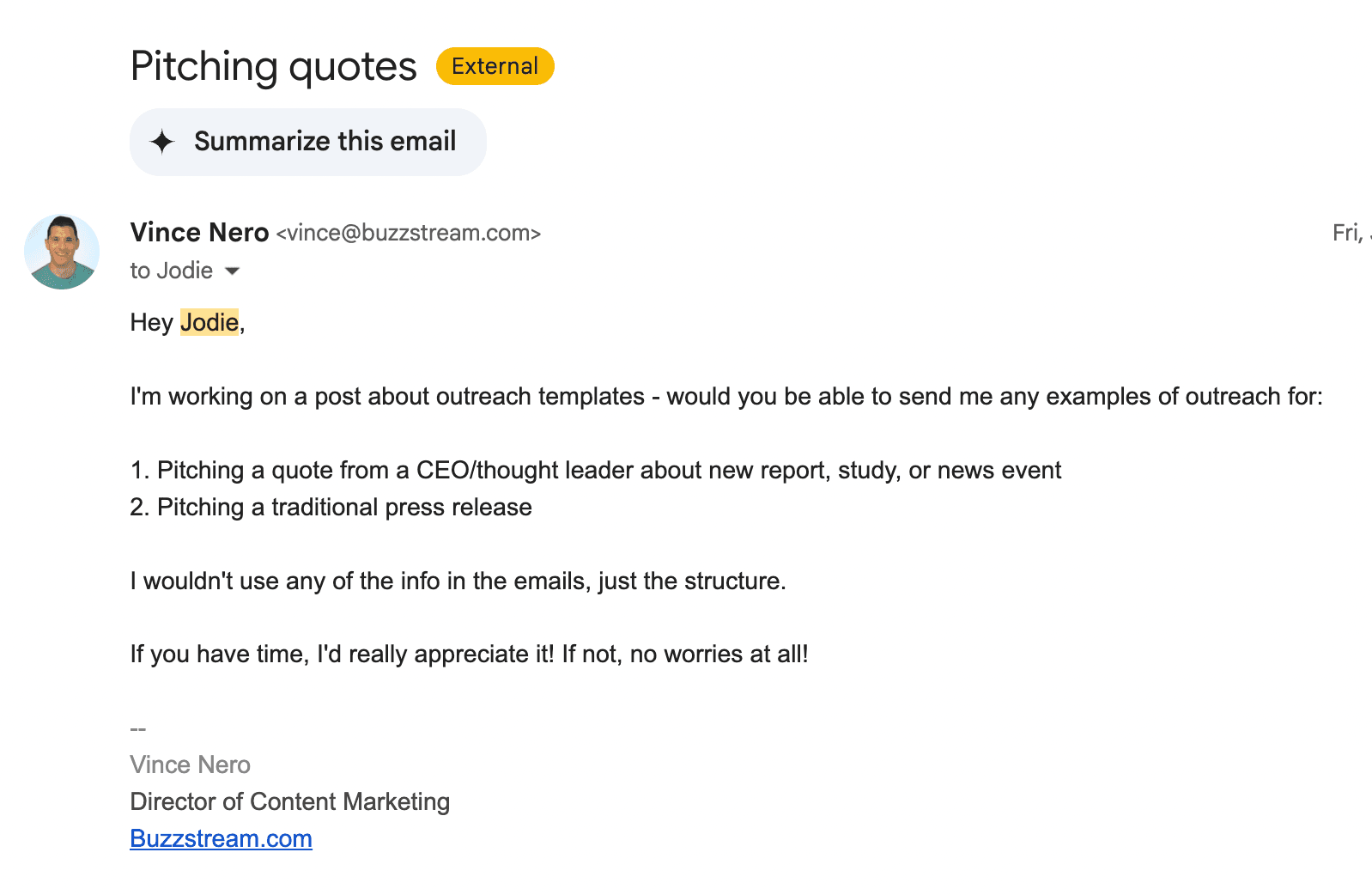
Guest post pitch
Subject: Article idea for [Blog Name]
Hi [First Name],
I have been reading [Blog Name] since I found your piece on [specific recent article] last month, and the section on [observation] made me rethink how I cover the topic on my own site. I write at [Your Site], where I focus on [niche], so I thought I would pitch two ideas your readers might enjoy.
- [Working title one]
- [Working title two]
Both would be 1,200 to 1,500 words, original, and tailored to your editorial style. Here are two recent samples of mine: [Link 1], [Link 2].
Happy to flesh out an outline if either lands.
Thanks, [Your Name with Contact Info]
Broken link pitch
Subject: Broken link on your page
Hi [First Name],
While reading your guide to [topic] this morning I noticed the link pointing to [broken page] no longer resolves. I wanted to flag it in case you wanted to swap it out.
I recently published a guide that covers the same ground with updated examples: [your resource link]. Either way, the broken link is worth a quick fix.
Thanks for putting that piece together, the framework you used in section three is genuinely useful.
Best, [Your Name]
Skyscraper / updated resource pitch
Subject: Updated resource on [topic]
Hi [First Name],
I noticed you linked to [outdated article] in your post about [topic]. The numbers in that piece are from 2021 and a few of the platforms it references have since shut down.
We published a more current take here: [your link]. It covers the same questions with 2026 data and walks through three new tools that have replaced the old ones.
If it is useful for your readers, swap it in. If not, no worries.
Best, [Your Name]
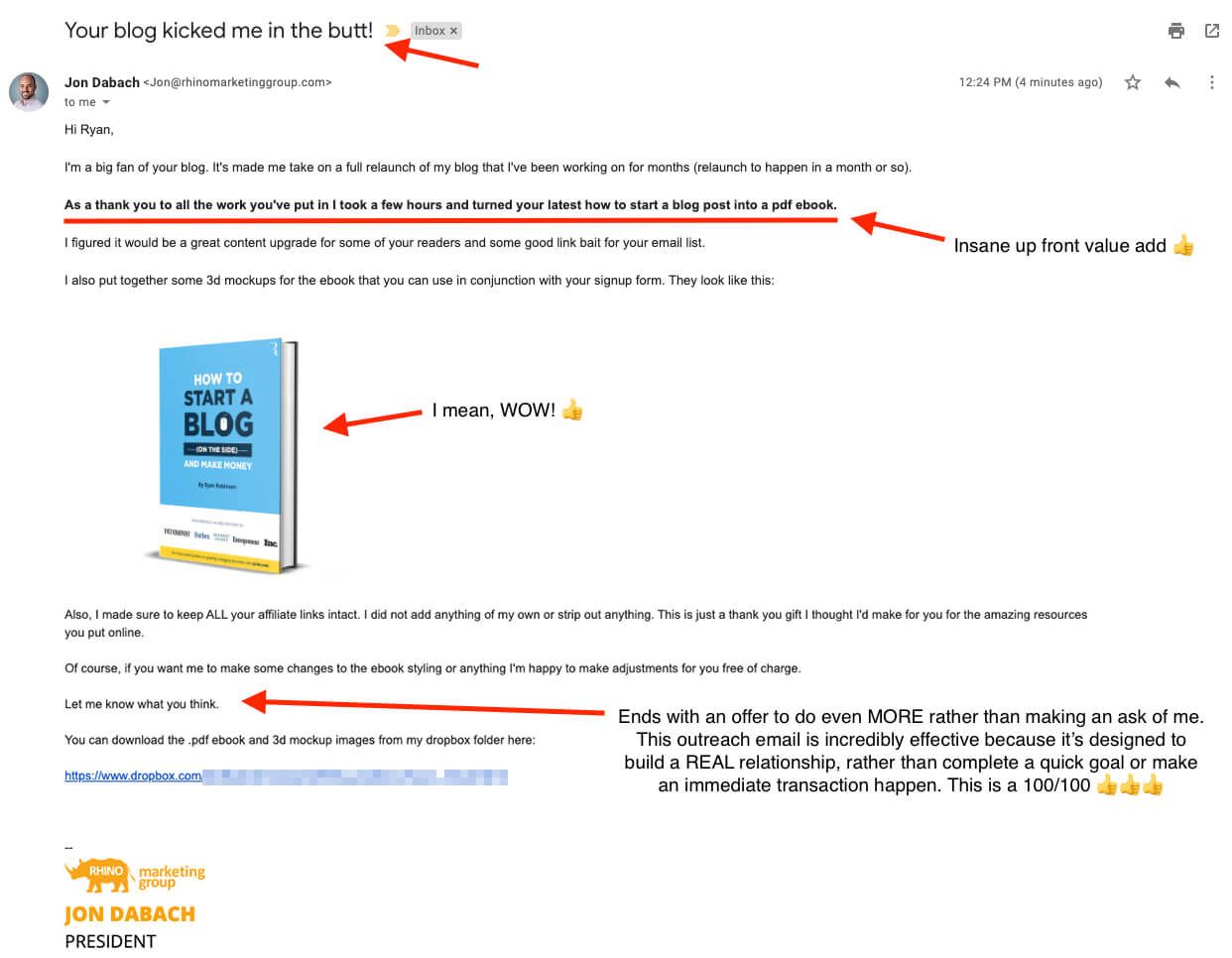
Resource share, no ask
Subject: Resource your readers might enjoy
Hi [First Name],
I came across your article on [topic] and the angle you took on [specific point] reminded me of a guide we put together last quarter: [your link].
No ask attached. If it fits a future piece, feel free to include it. If not, thanks for writing the original, it is one of the few clear takes on this corner of the topic.
Best, [Your Name]
Follow-up
Subject: Quick follow up
Hi [First Name],
Just circling back on the [working title] pitch I sent last week. Wanted to make sure it did not get buried.
If the timing is wrong, no problem. If either idea still looks workable, I can have an outline ready within 48 hours.
Best, [Your Name]
Send one follow-up, one week after the initial pitch. More than that and the response rate drops sharply, and you start training the blogger to filter your future emails into a folder they never check.
Five mistakes that quietly kill reply rates
Sending generic, cookie-cutter copy
Using the same wording across 200 publishers feels efficient. It is the fastest way to burn your sender reputation and your relationship with every blogger on the list. Bloggers compare notes, recognise patterns, and remember which domains keep sending the same form letter.
Trying too hard with empty compliments
Opening with "Your blog is amazing!" or "I have been a huge fan for years" reads as flattery the moment the rest of the email does not back it up. Replace generic praise with a specific paraphrase of one argument the blogger made recently. (For the writing-craft moves that replace empty praise with concrete openers, see cold email copywriting.)
Pitching with no topic ideas
Emails that simply ask "do you accept guest posts?" without proposing a topic get ignored. Bloggers do not want to brainstorm for a stranger. Bring 2 to 3 working titles and let them pick.
Acting overconfident
Assuming the blogger has heard of you, or framing the pitch as if you are doing them a favour, kills the thread. The guest contributor is always the one asking. Be humble, be specific, be brief.
Following up too many times
More than one follow-up reads as harassment. After the second silence, cut your losses and move on. You can return six months later with a different topic, but daily pings only train the blogger to mute the domain.
Deliverability for Blogger Outreach (the short version)
A template that should pull a 19 percent reply rate can drop to 2 percent overnight if your sending domain looks suspicious to inbox providers. Three quick checks specific to blogger outreach:
- Verify before the first batch. A 12 to 15 percent hard bounce rate on the first send is enough to flag your domain. Run the recipient list through a bulk email verifier before pressing send.
- Watch for catch-all blogger inboxes. Many small blogs route every address to one mailbox; a catch-all domain can quietly drop messages without bouncing.
- One follow-up only. Bloggers are quick to filter; the second nudge is the one that lands you in their muted-senders folder.
The complete sending-domain checklist (SPF/DKIM/DMARC, 30-day warmup, dedicated outreach domain, spam-trap avoidance, bounce-rate ceilings) is in the outreach 101 framework.
Before you hit send: a pre-flight checklist
A two-minute pass before each campaign catches the obvious blogger-specific mistakes:
- Is the first name correct, and spelled the way the blogger spells it?
- Does the opener reference a specific article published in the last 90 days?
- Are there 2 to 3 working titles, with no full draft attached?
- Is the entire pitch under 150 words and free of empty compliments?
- Have you verified the email address and confirmed the domain is not a catch-all?
- Is the follow-up scheduled for one week out, and only once?
If any answer is no, fix it before the send button gets pressed.
Quick answers about blogger outreach
How long should a blogger outreach email be?
Keep the initial pitch under 150 words. The opener is 3 to 5 sentences, the proposal is one short paragraph with 2 to 3 working titles, and the sign-off is one line. Anything longer gets skimmed.
What subject line works best for guest post pitches?
"Article idea for [Blog Name]" reads as specific and low-pressure. Avoid "Quick question" or "Re:" tricks, which feel manipulative and get caught by spam filters.
How often should I follow up on a blogger outreach email?
Once, one week after the initial pitch. A single follow-up captures most of the replies that would have come through anyway. Sending two or three reduces reply rates and damages your sender reputation.
How is blogger outreach different from cold email outreach?
Blogger outreach optimises for a guest-publishing decision rather than a meeting booking. The ask is concrete ("can I write this for you") rather than open ("would you be interested in learning more"), and the follow-up cadence is shorter (one nudge, not 3-4). The wider cold-email framework still applies for everything around the pitch — see email outreach 101 for the end-to-end stack.
§ Before your next send
Find the addresses that will bounce
Verify a single address free, or upload a CSV — the free plan includes 50 checks a month, no card needed.

BounceCheck Team
The team behind BounceCheck - helping businesses verify emails and improve deliverability.