DMARCbis (RFC 9989): What Changed and How to Update Your DMARC Record
 BounceCheck Team
Before your next send Find the addresses that will bounce.
Verify an email freeDMARC became an IETF Standards Track specification in May 2026. RFC 9989 replaces RFC 7489 (and RFC 9091), with aggregate reporting split out into RFC 9990 and failure reporting into RFC 9991. Your existing record keeps working, because it still starts with v=DMARC1. Three tags are gone (pct, ri, rf), three are new (t, np, psd), and the way receivers find your organizational domain has changed.
The short version
| Change | What it means for you |
|---|---|
pct removed | Stop using a percentage to ramp up enforcement. Use t=y while testing instead |
t added | Test mode. t=y asks receivers to apply your policy one level softer |
np added | A separate policy for subdomains that do not exist, a common spoofing trick |
psd added | Only for public suffix operators such as registries. Most senders never set it |
ri and rf removed | Report interval and failure report format are no longer set in the record. Delete them |
| DNS tree walk | Receivers find your organizational domain by walking up your DNS labels, not from the Public Suffix List |
Why pct was removed
The pct tag asked receivers to apply your policy to only a share of failing mail, so p=quarantine; pct=25 was meant to quarantine a quarter of it. The RFC's own explanation is that receivers rarely applied values other than 0 and 100 accurately, and implementations varied widely. A tag with only two dependable values was not worth keeping.
RFC 9989 also tells receivers to ignore tags they do not recognise. A leftover pct will not break your record, but you should no longer count on it to control how much mail gets quarantined.
The new t tag: test mode
t takes two values. t=n is the default and means "apply my policy as written". t=y asks the receiver to apply your policy one level softer: reject is treated as quarantine, and quarantine as none. It has no effect when your policy is already p=none, and it does not change the reports you receive.
In practice t=y plays the role that pct=0 used to, and t=n the role of pct=100. A safe rollout now looks like this:
p=nonewithruareporting on. Read your aggregate reports until every legitimate sender passes SPF or DKIM in alignment.p=quarantine; t=ywhile you watch for anything you missed.p=quarantine(dropt, or sett=n).p=reject; t=y, thenp=reject.
The new np tag: subdomains that do not exist
Attackers like to send from made-up subdomains such as billing.example.com when that name has no DNS records at all. np sets the policy for exactly those names, and only those. It uses the same values as p: none, quarantine or reject. If you leave it out, receivers fall back to sp, then to p.
If your real mail only comes from your root domain and a few named subdomains, np=reject closes that gap without touching legitimate traffic.
Before and after: rewriting a record
A typical record written for RFC 7489:
v=DMARC1; p=quarantine; pct=25; rua=mailto:[email protected]; ri=86400; rf=afrfThe same intent under RFC 9989:
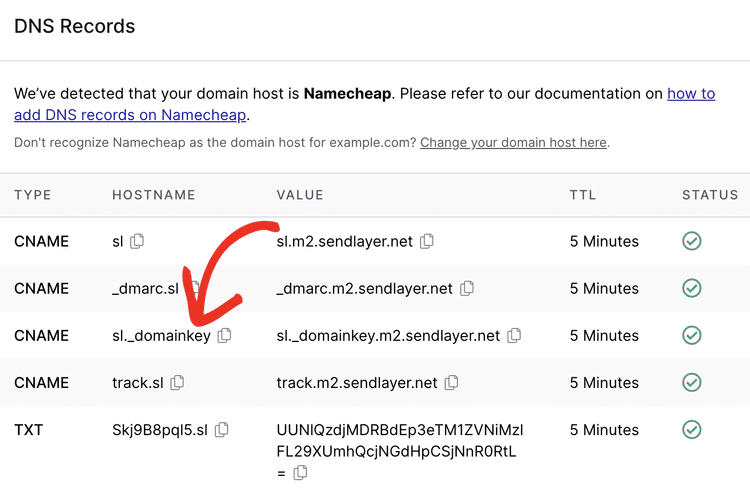
v=DMARC1; p=quarantine; t=y; np=reject; rua=mailto:[email protected]pct=25 becomes t=y (test mode), ri and rf go, and np=reject is added only if you are sure no real mail comes from undeclared subdomains. You can build the record with our DMARC generator.
The DNS tree walk
DMARC needs to know your organizational domain, for example to check whether mail.example.com is aligned with example.com. RFC 7489 relied on the Public Suffix List for this. RFC 9989 has receivers walk up the DNS labels of the From domain and read the DMARC records they find on the way, capped at eight lookups. The new psd tag lets registries mark a domain as a public suffix during that walk.
For a normal company domain the result is usually the same as before. Check it if you run a deep subdomain structure or publish DMARC records at several levels.
What to do now
- Nothing breaks today. Receivers ignore tags they do not recognise, so an RFC 7489 record still validates.
- Replace any
pctvalue below 100 witht=yif you are still in a rollout, and droppct=100entirely. - Delete
riandrf. They do nothing under the new standard. - Consider
np=rejectonce your aggregate reports show no legitimate mail from undeclared subdomains.
Authentication tells mailbox providers the mail is really yours. It does not stop bounces from dead addresses, which hurt your sender reputation just as much. Before a big send, check your list for invalid addresses.
FAQs
Is RFC 7489 still valid?
No. RFC 9989 obsoletes it. Records written for RFC 7489 still work because the version tag is unchanged and unknown tags are ignored.
Do I need to change v=DMARC1?
No. The version tag stays v=DMARC1.
What replaces pct=0?
t=y. The RFC describes t=y and t=n as working like pct=0 and pct=100.
Where did the reporting rules go?
Aggregate reports are now defined in RFC 9990 and failure reports in RFC 9991.
§ Before your next send
Find the addresses that will bounce
Verify a single address free, or upload a CSV — the free plan includes 50 checks a month, no card needed.

BounceCheck Team
The team behind BounceCheck - helping businesses verify emails and improve deliverability.