Inbox Placement Rate Explained: What It Is and How to Improve It
 BounceCheck Team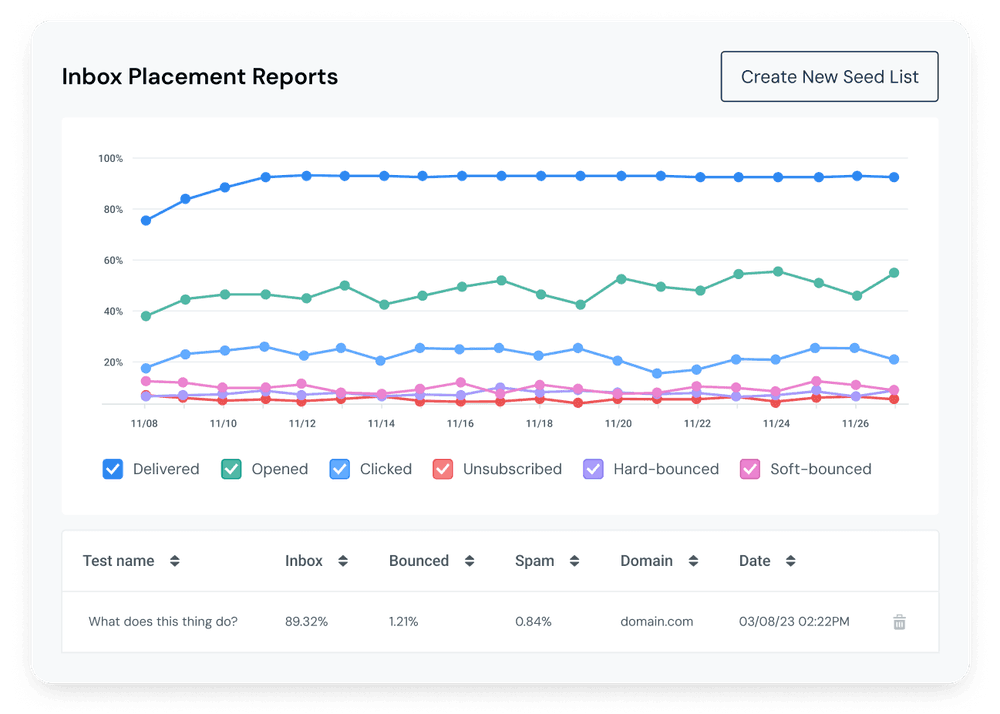
Before your next send Find the addresses that will bounce.
Verify an email freeYour delivery report says 98 percent of your last campaign was delivered. Great. But how many of those emails actually landed in someone's primary inbox, and how many slid into Promotions, Updates, or the spam folder? That gap is what inbox placement rate measures, and it is the metric that decides whether your hard-won open rate has any chance to happen at all.
What is inbox placement rate?
Inbox placement rate (IPR) is the percentage of your delivered emails that reach the recipient's primary inbox rather than the spam folder, the promotions tab, or another secondary view. It is the metric that sits between deliverability and open rate, and it is the one most senders never look at.
Think of the journey as three gates. The first gate is deliverability: did the receiving mail server accept the message at all. The second gate is inbox placement: where did the server file it. The third gate is the open: did a human actually click. The first two gates decide everything that happens at the third.
Inbox placement matters because most people never browse their spam folder, and many ignore the Promotions tab in Gmail. A message that lands there is technically delivered but functionally invisible. Open rates, click-through rates, and conversions all drop with poor placement, which is why IPR is the lead indicator most deliverability teams watch.
What does inbox placement mean?
Inbox placement refers to the specific folder where a delivered email ends up. After a mailbox provider accepts the message, its filtering algorithms decide whether to drop it in the primary inbox, the Promotions or Updates tab, the spam folder, or another category. Inbox placement is that filing decision, and inbox placement rate is the number that summarizes it across a campaign.
How is inbox placement rate calculated?
There are two formulas in common use, and they disagree on the denominator.
Mailgun's definition (delivered-based):
IPR = Emails in the inbox / Emails delivered
This version excludes hard bounces, because those messages never made it through the gate in the first place.
Twilio Sendgrid's definition (sent-based):
IPR = (Emails in the inbox / Total emails sent) x 100
This version treats every send as part of the denominator, including bounces.
Both are valid. The delivered-based version isolates the placement decision from list quality, while the sent-based version rolls list quality and placement into one number. Pick one, document it, and stick with it across every report you publish.
A worked example using the sent-based version: send 100 emails, 95 reach the inbox, and your IPR is 95 percent.
What counts as a good inbox placement rate?
90 percent or higher is the working benchmark for IPR, and 96 percent is what Twilio Sendgrid quotes as a strong industry average. Anything below 85 percent is a signal to stop and audit the program before sending the next campaign.
Inbox placement rate vs delivery rate
These two metrics get confused constantly, so it is worth pinning the distinction down.
Delivery rate measures whether the receiving mail server accepted your message into any folder. A typical healthy program runs at around 98 percent delivery. Inbox placement rate measures what happened next, inside that acceptance: how many of those accepted emails reached the primary inbox specifically.
You can have a 98 percent delivery rate and a 60 percent inbox placement rate at the same time. The first number says the gate opened. The second says the mailbox provider sent most of your traffic to the back room.
What affects inbox placement rate?
Four factors do most of the work.
Sender reputation: Mailbox providers score every sending IP and domain based on history. High engagement, low complaints, and consistent volume push the score up. The score is the single biggest input into the placement decision.
Email authentication: SPF, DKIM, and DMARC verify that the message actually came from the domain it claims to be from. Without them, you look like a phishing risk and your mail gets filtered accordingly. BIMI is the optional fourth layer that lets your logo render next to authenticated messages.
Subscriber engagement: Mailbox providers watch how recipients react. Opens, replies, and moves out of spam improve placement. Long stretches of unopened mail, deletions without opens, and spam complaints push you the other way.
Content signals: Excessive capitalization, misleading subject lines, broken HTML, image-heavy bodies with little text, and link patterns associated with spam all trigger filters. This is also where the 60/40 rule comes in: keep your email at roughly 60 percent text and 40 percent images, with at least 400 characters (60 to 100 words) of plain text outside of any images, so a filter can actually read the message.
Five ways to improve your inbox placement rate
1. Keep your list clean
Cleanliness drives IPR more than any clever subject line. Grow the list organically, never buy or scrape addresses, and prune inactive subscribers on a regular cadence. A smaller engaged list outperforms a large stale one every time. Real-time email verification at the signup form catches typos and disposable addresses before they enter the list, and that single step protects your bounce rate and your sender reputation.
2. Implement double opt-in
Double opt-in asks each new subscriber to confirm by clicking a link in a follow-up email. Yes, the list grows more slowly. The trade is quality: the people who confirm are the people who will actually open, which is what mailbox providers reward.
3. Set up SPF, DKIM, and DMARC
Authentication is the cheapest single intervention with the largest payoff. SPF tells receivers which servers are allowed to send for your domain. DKIM cryptographically signs each message. DMARC tells receivers what to do if SPF or DKIM fails, and it gives you reports on who is using your domain. Without these three, expect placement to suffer no matter how clean your list is.
4. Match cadence to engagement
Sending too often raises complaints, and sending too rarely lets subscribers forget who you are. Segment by behavior and tune frequency per segment. Some lists tolerate three sends a week, others want one a month. For cold outreach specifically, practitioners talk about the 30/30/50 rule: 30 percent of effort on subject-line personalization, 30 percent on deliverability fundamentals, and 50 percent on follow-ups, since most replies arrive after the first send. The exact split is less important than the underlying point, which is that cadence and follow-up shape engagement, and engagement shapes placement.
5. Test before you send
Inbox placement testing uses a seed list of addresses across major mailbox providers (Gmail, Outlook, Yahoo, Apple) to predict where a campaign will land before the real send goes out. Per Mailgun's research on inbox placement, only 13 percent of senders run this kind of test, which is one of the larger missed opportunities in the field. Test, read the per-provider breakdown, fix what is broken, then send.
Where IPR fits in the wider email funnel

Twilio frames the email funnel as an obstacle course: deliverability is the first hurdle, inbox placement is the second, and open rate is the third. Each stage caps the next. You cannot get an open rate above your inbox placement rate, and you cannot get an inbox placement rate above your delivery rate. Working on subject lines is fine, but if IPR is 60 percent then the ceiling on opens is already 60 percent, no matter how clever the copy is. Fix placement first, then optimize for opens. The Twilio team walks through the calculation step by step and frames the same funnel logic.
The senders who win on email are the ones who treat inbox placement rate as a primary KPI and review it after every campaign. Track it, understand which factor is pushing it around, and the rest of the funnel takes care of itself.
§ Before your next send
Find the addresses that will bounce
Verify a single address free, or upload a CSV — the free plan includes 50 checks a month, no card needed.

BounceCheck Team
The team behind BounceCheck - helping businesses verify emails and improve deliverability.