BounceCheck vs MillionVerifier (2026): Which Email Verifier Wins?
 BounceCheck Team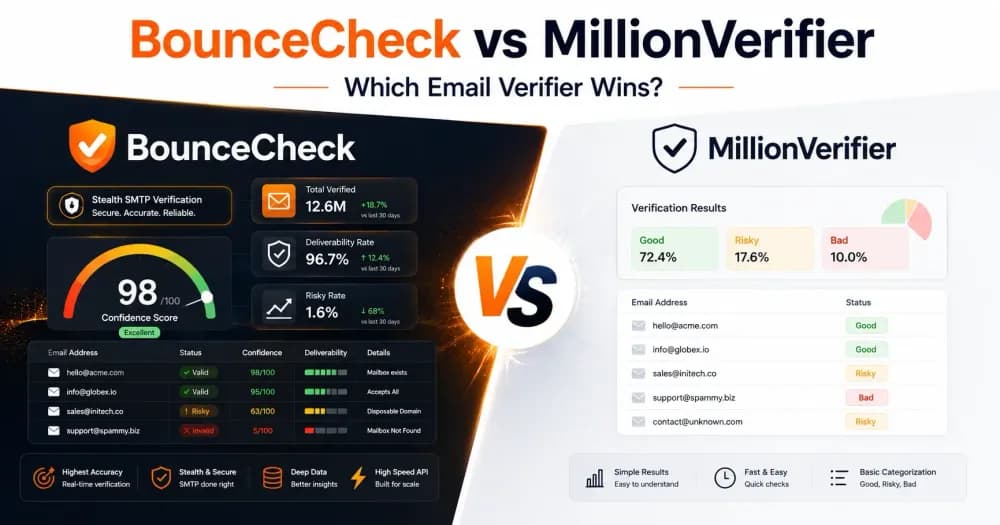
Picking an email verifier is mostly a question of how deep the pipeline goes, how transparent the result is, and how much you pay per address. BounceCheck and MillionVerifier sit on opposite ends of that trade-off. One returns a 0-100 confidence score built from a 30-step diagnostic engine. The other returns a Good, Risky, or Bad label and competes on price. Both have their place, and this comparison walks through where each one wins so you can match it to your sending workflow. If you are new to the category, our explainer on how email verification works covers the underlying checks both tools rely on.
BounceCheck
BounceCheck is built for teams that care about verification depth and scoring flexibility. Every email passes through a 30-step diagnostic engine covering syntax, domain, MX, stealth SMTP, catch-all, disposable, role-based, and spam trap checks, then returns a 0-100 confidence score you can threshold however you want.
Pros:
- 30-step verification pipeline with 0-100 confidence scoring per email
- Stealth SMTP handshake that never notifies the recipient or exposes your domain
- REST API with webhook callbacks and SDKs for Python, Node.js, Ruby, Go, PHP, and cURL
- TLS 1.3 + AES-256 encryption, GDPR and CCPA compliant
- 14-day money-back guarantee, credits never expire
Cons:
- Email-only support (no live chat or phone)
- Smaller native integration list compared to MillionVerifier's 35 direct connections
MillionVerifier
MillionVerifier markets itself as the most affordable bulk email verification service. The platform runs syntax, domain, DNS, and SMTP checks, classifying addresses into Good, Risky, and Bad categories. Its EverClean feature automates daily list hygiene inside connected ESPs.
Pros:
- Competitive bulk pricing with credits that never expire
- 35 native integrations with major ESPs and CRMs
- EverClean automated daily verification for connected platforms
- 100% money-back guarantee if hard bounce rate exceeds 4%
- 500 free credits at signup, no credit card required
Cons:
- No real-time single email verification through the web app, batch processing focused
- No confidence scoring, emails are classified as Good, Risky, or Bad only
- Customer support response times reported up to 72 hours
- Standard SMTP validation without stealth verification
- Limited API documentation with no official SDKs
Ratings at a glance
| Category | BounceCheck | MillionVerifier |
|---|---|---|
| Overall | 4.8 / 5 | 4.4 / 5 |
| Ease of Use | 5/5 | 4/5 |
| Value for Money | 5/5 | 5/5 |
| Customer Support | 4/5 | 3/5 |
| Functionality | 5/5 | 4/5 |
Key differences that set them apart
| Feature | BounceCheck | MillionVerifier |
|---|---|---|
| Verification Depth | 30-step diagnostic pipeline | Standard syntax, domain, DNS, SMTP checks |
| SMTP Method | Stealth SMTP (zero recipient notification) | Standard SMTP validation |
| Scoring | 0-100 confidence score per email | Good / Risky / Bad categories |
| Real-Time Verification | Yes (single + bulk + API) | Batch processing via file upload and API |
| API & SDKs | REST API, webhooks, 6 SDKs | REST API, basic docs, no official SDKs |
| Automated List Cleaning | Not available | EverClean (daily automated verification) |
| Encryption | TLS 1.3 + AES-256 | GDPR compliant, standard encryption |
| Compliance | GDPR + CCPA | GDPR |
| Support Response | Email (~20 min) | Email (up to 72 hours reported) |
| Money-Back Guarantee | 14-day on unused credits | 100% refund if bounce rate > 4% |
| Free Tier | 50 verifications/month (recurring) | 500 one-time credits |
The scoring model is the biggest functional gap. BounceCheck returns a number you can threshold (send at 80+, suppress at 50-, flag 50-79 for review). MillionVerifier returns three labels, which forces you to trust their classification or live with the ambiguity of Risky. For teams running cold outreach where false negatives cost real revenue, that granularity matters. The same goes for catch-all detection: a binary verdict on catch-all domains is far less useful than a graded confidence reading.
Features in common
Both tools cover the verification basics:
- Bulk email verification
- Syntax validation
- Domain and DNS verification
- SMTP verification
- Disposable email detection
- Catch-all detection
- Spam trap detection
- Duplicate removal
- API access
- Greylisting handling
- Role-based account detection
- CSV / file upload support
- Credits that never expire
Unique to BounceCheck
- 0-100 confidence scoring
- Stealth SMTP (zero footprint)
- Webhook callbacks for async processing
- 6 official SDKs (Python, Node.js, Ruby, Go, PHP, cURL)
- Team accounts with scoped permissions
- CCPA compliance
- TLS 1.3 + AES-256 encryption
Unique to MillionVerifier
- EverClean automated daily verification
- 35 native ESP / CRM integrations
- Free EmailAcademy PRO access (blacklist monitoring, inbox testing)
- Sub-user accounts
- Auto top-up with 10% bonus credits
- 100% money-back guarantee (bounce-rate based)
If you live inside a single ESP and want hands-off list hygiene, MillionVerifier's EverClean is genuinely useful. If you are wiring verification into a product workflow or scoring leads at form submission, BounceCheck's SDKs and webhooks remove a lot of integration plumbing.
Integrations
BounceCheck:
| Integration | Type |
|---|---|
| Zapier | Automation (connects to 3,000+ apps) |
| Mailchimp | Email Marketing |
| HubSpot | CRM / Marketing |
| Klaviyo | Email Marketing |
| Shopify | E-commerce |
| WooCommerce | E-commerce |
| Typeform | Forms |
REST API with SDKs for cURL, Python, Node.js, Ruby, Go, and PHP.
MillionVerifier: 35 native integrations including Mailchimp, HubSpot, ActiveCampaign, AWeber, GetResponse, MailerLite, Campaign Monitor, Constant Contact, ConvertKit, SendGrid, Mailgun, Mailjet, Drip, Omnisend, Intercom, Pipedrive, Zoho CRM, Sendy, Smartlead, Freshsales, Snov.io, Zapier, and more.
MillionVerifier wins on breadth of native ESP and CRM connections. BounceCheck wins on developer surface area: official SDKs in 6 languages and webhook callbacks for async workflows are missing on the MillionVerifier side. Pick based on whether your verification lives inside a marketing tool or inside an application.
Pricing comparison
| Volume | BounceCheck | MillionVerifier |
|---|---|---|
| Free | 50/month (recurring) | 500 one-time credits |
| 10,000 emails | $9.99 | $37 |
| 50,000 emails | $29.99 | ~$145 |
| 100,000 emails | Custom / Enterprise | ~$189 |
| 1,000,000 emails | Custom / Enterprise | ~$359 |
| Credits Expiry | Never | Never |
| Money-Back | 14-day on unused credits | 100% if bounce > 4% |
At the most common volume tier (10K), BounceCheck costs $9.99 versus MillionVerifier's $37, less than one-third of the price. MillionVerifier publishes transparent pricing at higher volumes (100K to 1M) and offers bonus credits on large purchases, while BounceCheck provides custom enterprise rates for large-scale needs. MillionVerifier does not charge for catch-all or unknown emails, which can lower effective costs for lists with many ambiguous addresses. For broader pricing context, see our roundup of email bounce checker tools.
Deployment and support

| Detail | BounceCheck | MillionVerifier |
|---|---|---|
| Deployment | Cloud / SaaS | Cloud / SaaS |
| Supported Devices | Web browser, API | Web browser, API |
| Support Channels | Email (~20 min response) | Email (up to 72 hours reported) |
| Live Chat | No | No |
| Phone Support | No | No |
| Documentation | API docs + SDK examples | Help center + API docs |
| Free Trial | 50 verifications/month | 500 one-time credits |
Neither tool offers live chat or phone support. Response speed is where they diverge sharply: BounceCheck's email turnaround is reported at around 20 minutes, while MillionVerifier users report waits up to 72 hours during busy periods. If verification is on the critical path for a campaign launch, that gap is worth weighing.
Which one fits your stack
MillionVerifier is a fair pick if you are cleaning a list once, you live entirely inside one of its 35 native ESPs, and you want EverClean to handle ongoing hygiene without writing code. The Good / Risky / Bad classification is enough when the downstream platform just needs a yes-or-no on whether to send.
BounceCheck makes more sense when you need a confidence score you can threshold, when you are verifying inside a product flow rather than a marketing tool, or when your team is sensitive to recipient-side noise from SMTP probing. The 0-100 score lets you set policy per use case (block under 40, queue 40-70 for review, send 70+), and stealth SMTP keeps your verification invisible to recipient mail servers. At 10K verifications, you also pay roughly a third of what MillionVerifier charges for a deeper pipeline.
If you are weighing other comparisons in the same category, our breakdown of ZeroBounce vs Kickbox covers another common matchup, and our list of MillionVerifier alternatives walks through 7 tools worth comparing side by side.
Ready to try BounceCheck? Sign up for free at bouncecheck.email, no credit card required, 50 verifications per month on the free tier.
Last updated: May 2026

BounceCheck Team
The team behind BounceCheck - helping businesses verify emails and improve deliverability.