Kickbox vs Bouncer: Which Email Verifier Wins in 2026?
 BounceCheck Team
Before your next send Find the addresses that will bounce.
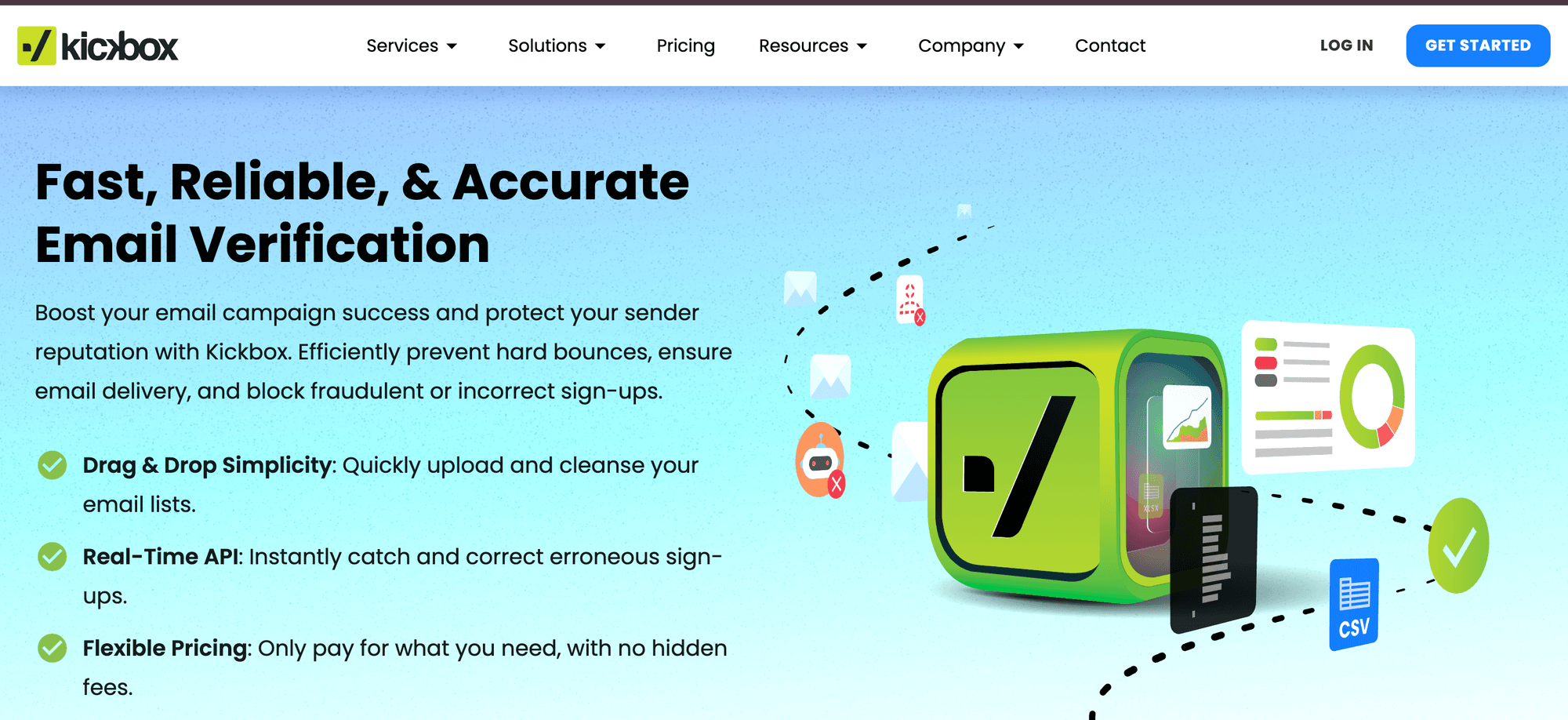
Verify an email freeKickbox is the polished US-based incumbent owned by Validity. Bouncer is the leaner Polish challenger that markets itself as GDPR compliant by design. Both verify, both have non-expiring PAYG credits, both publish 99% accuracy claims. The price tag and data residency are where they actually split.
The short version:
- Pick Kickbox if you want a US-based, anti-spam-focused verifier with the Sendex deliverability score, Validity-backed enterprise stability, and developer documentation that is genuinely good.
- Pick Bouncer if you want EU data residency, ~37% lower cost per email at the entry tier ($0.005 vs $0.008), GDPR compliant by design, and Bouncer Shield for form-level signup protection.
- If you want both EU-style privacy posture and sub-500ms API at $0.001 per email, BounceCheck is a third option worth running through the same test list.
Why people compare Kickbox and Bouncer
Most teams comparing these two are doing one of three things:
- Cost-shopping. Kickbox is $0.008 per email. Bouncer is $0.005. On a 100,000-email cleanup that is a $300 gap.
- Compliance-checking. Kickbox is US-based. Bouncer is GDPR compliant by design with EU infrastructure. For European businesses, that detail goes from "nice to have" to "required."
- Looking for fewer dashboards. Both are pure verification, but Kickbox throws in the Sendex score (a 0 to 1 deliverability prediction) and Bouncer adds Bouncer Shield + a Deliverability Kit on top of basic verification.
The pain points show up in three predictable spots: Kickbox pricing scales linearly with no real volume discount past mid-tier, Bouncer's smaller G2 footprint means fewer third-party reviews to read, and neither tool resolves catch-all addresses (both flag, neither completes the check).
Kickbox vs Bouncer: side-by-side
| Feature | Kickbox | Bouncer |
|---|---|---|
| Parent company | Validity | Independent (Poland) |
| Data residency | US-based | EU-based |
| Claimed accuracy | 95% guaranteed (vendor claim 99%) | 99.5% |
| Free credits | 100 on signup | 100 on signup |
| PAYG entry price | $0.008/email flat | $0.005/email |
| 100,000 verifications | ~$800 | ~$150 |
| 1,000,000 verifications | ~$4,000 | ~$750 |
| Credits expire | No, never expire | No, never expire |
| GDPR | Compliant | Compliant by design |
| Catch-all detection | Flagged, not resolved | Flagged, not resolved |
| Disposable detection | Yes | Yes |
| Quality score | Sendex (0 to 1) | Risk assessment + confidence |
| Form-level protection | No | Bouncer Shield |
| Integrations | 30+ | 20+ (Zapier, Make, ESPs) |
| Standout feature | Sendex score + Validity ownership | EU residency + Bouncer Shield + Toxicity Check |
| Support | Email + docs (no live chat) | Chat + email + video call, 24/7 |
| Best for | Quality-focused US senders | EU businesses, cost-conscious teams |
Numbers cross-checked against emailverifiers.com's Bouncer vs Kickbox breakdown and Bouncer's published Kickbox alternative comparison.
Kickbox: strengths and weaknesses
Strengths
- Validity ownership. If your procurement team asks who is behind the verifier, Validity (parent of BriteVerify, NeverBounce, Return Path) checks every enterprise stability box.
- Sendex Score (0 to 1) is genuinely useful for programmatic use. Set business logic: only email above 0.6, manual review below 0.3, suppress under 0.2.
- Excellent API documentation. Clean endpoints, predictable responses, multiple language libraries.
- Strong anti-spam stance. Kickbox actively refuses customers it suspects of bad list practices, which protects the shared SMTP reputation.
- Credits never expire on PAYG. No 12-month clock like NeverBounce.
Weaknesses
- Pricing. $0.008 per email is competitive at low volume and uncompetitive past 50k.
- US data residency is a problem for EU businesses with strict data processing requirements.
- 30+ integrations is functional but smaller than NeverBounce's 80+.
- No automated recurring list hygiene (you build the cron yourself).
- Support is ticket and docs only. No live chat, no 24/7 coverage.
Best for: US-based marketing and sales teams that want premium verification quality with the Sendex score baked into their workflow, and teams that value Validity's enterprise stability.
Bouncer: strengths and weaknesses
Strengths
- Roughly 37% to 60% cheaper than Kickbox at every published volume tier. $150 vs $800 at 100k. $750 vs $4,000 at 1M.
- GDPR compliant by design. EU-based infrastructure, anonymized data at rest, on-demand deletion.
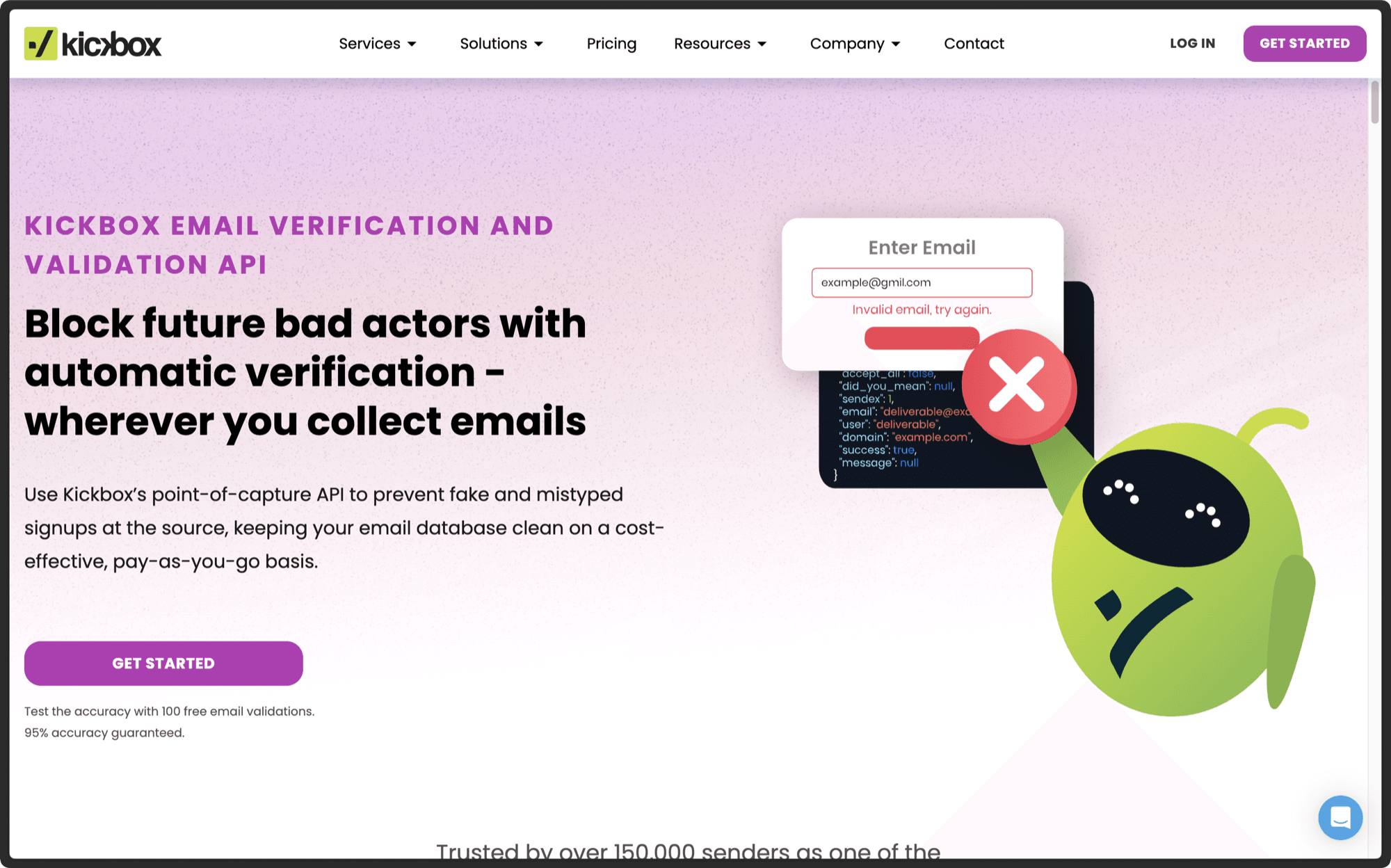
- Bouncer Shield blocks invalid signups in real time at the form level. Kickbox does not have a direct equivalent.
- Toxicity Check flags abusive/harmful addresses. Kickbox limits this kind of detection.
- 24/7 personalized support across chat, email, and video call.
- Credits never expire on PAYG.
Weaknesses
- Smaller G2 footprint than Kickbox, so less third-party review depth to read through.
- 20+ integrations is a fraction of Kickbox's connector list (and a fraction of NeverBounce's 80+).
- No automated recurring hygiene as a productized feature.
- Catch-all results are flagged as "risky" rather than scored on a 0 to 1 scale like Sendex.
Best for: EU-based businesses and cost-conscious senders who want privacy-by-design verification, form-level protection, and the lowest per-email cost without sacrificing accuracy.

How to choose between Kickbox and Bouncer
Use this short decision tree:
- You're an EU business with GDPR procurement requirements? Bouncer. Data residency closes the deal.
- You verify 100,000+ emails per month and price matters? Bouncer. The gap compounds at scale.
- You need a programmatic deliverability score for business logic? Kickbox. Sendex is the better tool for this.
- Procurement requires a Validity-backed enterprise vendor? Kickbox.
- You want form-level signup protection plus verification? Bouncer Shield is the only equivalent in this comparison.
- You verify in unpredictable bursts? Tie. Both have non-expiring PAYG credits.
Kickbox and Bouncer are not the only bulk email verifiers worth shortlisting. A third option to run in parallel is BounceCheck. It runs a 30-step verification engine with a stealth SMTP layer (verifies without notifying recipients), prices Starter at $9.99 for 10,000 credits ($0.001 per email, half of Bouncer's PAYG and one-eighth of Kickbox), and returns Valid, Risky, or Invalid plus a 0 to 100 confidence score with sub-500ms API responses. Honest gaps: BounceCheck is newer (founded 2021), has no public G2 page yet, monthly credits do not roll over, and standard tiers cap at 50,000 verifications. If your volume fits inside that envelope and EU privacy posture matters, it is worth a 1,000-email side-by-side test.
Test before you commit
Don't over-index on the headline price. Run the same 1,000-email sample through Kickbox, Bouncer, and one challenger like BounceCheck. Look at three things:
- Agreement rate on Valid addresses. It should be above 95% across all three.
- Disagreement on Risky and Catch-all. This is where Kickbox's Sendex score and Bouncer's risk flag actually diverge.
- False-positive rate on a known-good list of 100 addresses you control.
Both Kickbox and Bouncer detect disposable domains, but if you only need to spot-check a single suspicious address before adding it to a list, BounceCheck's free disposable email checker handles it without an account.
FAQs
Is Kickbox or Bouncer more accurate?
Kickbox publishes a 95% accuracy guarantee with a vendor claim around 99%. Bouncer claims 99.5%. On a real-world test of identical lists, both land in the 96 to 99% range. The accuracy gap is too small to be the deciding factor. Pricing and data residency usually decide the choice. Both sit in the top tier alongside the other major email bounce checker tools.
Is Kickbox legit?
Yes. Kickbox is owned by Validity (which also owns BriteVerify, NeverBounce, and Return Path), supports real-time and batch verification, and publishes a 95% accuracy guarantee. It is one of the most established names in the category.
Where is Bouncer based and is it GDPR compliant?
Bouncer is a Polish company with EU-based infrastructure. It markets itself as GDPR compliant by design with anonymized data at rest and on-demand deletion. For European businesses with strict data processing requirements, the EU residency is the main reason teams pick Bouncer over Kickbox.
Do credits expire on either platform?
No. Both Kickbox and Bouncer offer non-expiring PAYG credits. This is a notable advantage over NeverBounce (12-month expiry) and ZeroBounce ONE (monthly subscription expiry).
Which is cheaper at scale?
Bouncer, by a wide margin. At 100,000 verifications, Bouncer charges around $150 versus Kickbox's $800. At 1,000,000 verifications, the gap is roughly $750 vs $4,000.
What does Bouncer Shield do that Kickbox does not?
Bouncer Shield is a form-level API that blocks invalid signups in real time as users type their email. Kickbox has a real-time verification API but no equivalent productized form-protection product. For SaaS signup forms and lead-capture pages, Shield removes invalid addresses before they enter the database.
Is there a similar comparison for other tools?
Yes. See our deep-dives on BounceCheck vs Bouncer, ZeroBounce vs Bouncer, and NeverBounce vs Kickbox for the head-to-head breakdowns.
Final thoughts
Kickbox and Bouncer are both legitimate verifiers. The decision usually collapses to two questions: where does your data need to live, and how much volume are you running?
If the answer is "US is fine, premium feature set matters more than headline price," Kickbox earns the spend. If the answer is "EU residency is non-negotiable" or "I'm verifying 50k+ per month and price compounds," Bouncer is the cleaner pick.
And if you want EU-grade privacy posture, sub-500ms API responses, and PAYG pricing at $0.001 per email, BounceCheck is the third name to put in the same test sample. Start free, 100 verifications, no card required.
§ Before your next send
Find the addresses that will bounce
Verify a single address free, or upload a CSV — the free plan includes 50 checks a month, no card needed.

BounceCheck Team
The team behind BounceCheck - helping businesses verify emails and improve deliverability.