Real-Time vs Bulk Email Verification: When to Use Each
 BounceCheck Team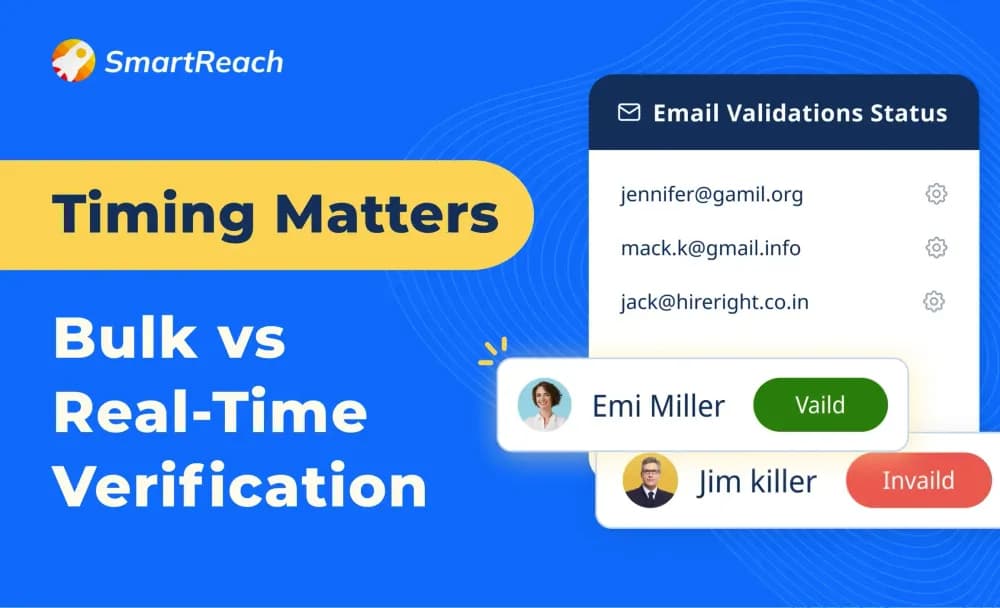
Before your next send Find the addresses that will bounce.
Verify an email freeYour contact data quietly decides whether the next campaign converts or burns. According to Validity's research, 37 percent of CRM users say poor data quality is a direct cause of lost revenue, and the Customer Data Platform Institute puts annual email-list decay at roughly 23 percent. Two tools sit between you and that decay. Real-time verification stops bad addresses before they enter your system. Bulk verification scrubs the addresses already inside it. Pick the wrong one for the job and you either let garbage in, or you ship a campaign on top of months of rot.
This guide breaks down what each one actually does, where they fail, and how senders are running both together in 2026.
Real-time email verification: the gatekeeper
Real-time verification is the check that fires the moment someone types an address into a form. It runs through an API in the background and answers a narrow question: if you sent mail to this address right now, would there be a mailbox on the other end to take it? Syntax is checked. The domain is resolved. The mailbox is probed. If the user fat-fingered gmial.com, a good verifier surfaces a "Did you mean" prompt and saves the lead instead of losing it.
Where it earns its keep. Real-time shines anywhere a new contact is being captured and a typo or a burner address costs you money:
- New account creation and product signups
- Newsletter and gated content forms
- Ecommerce checkout, where the order confirmation has to reach a real inbox
- High-intent demo requests in B2B funnels
For any business that depends on rapid lead generation or repeat customers, a real-time API at every capture point is one of the cheapest investments in deliverability you can make.
How real-time checks actually work
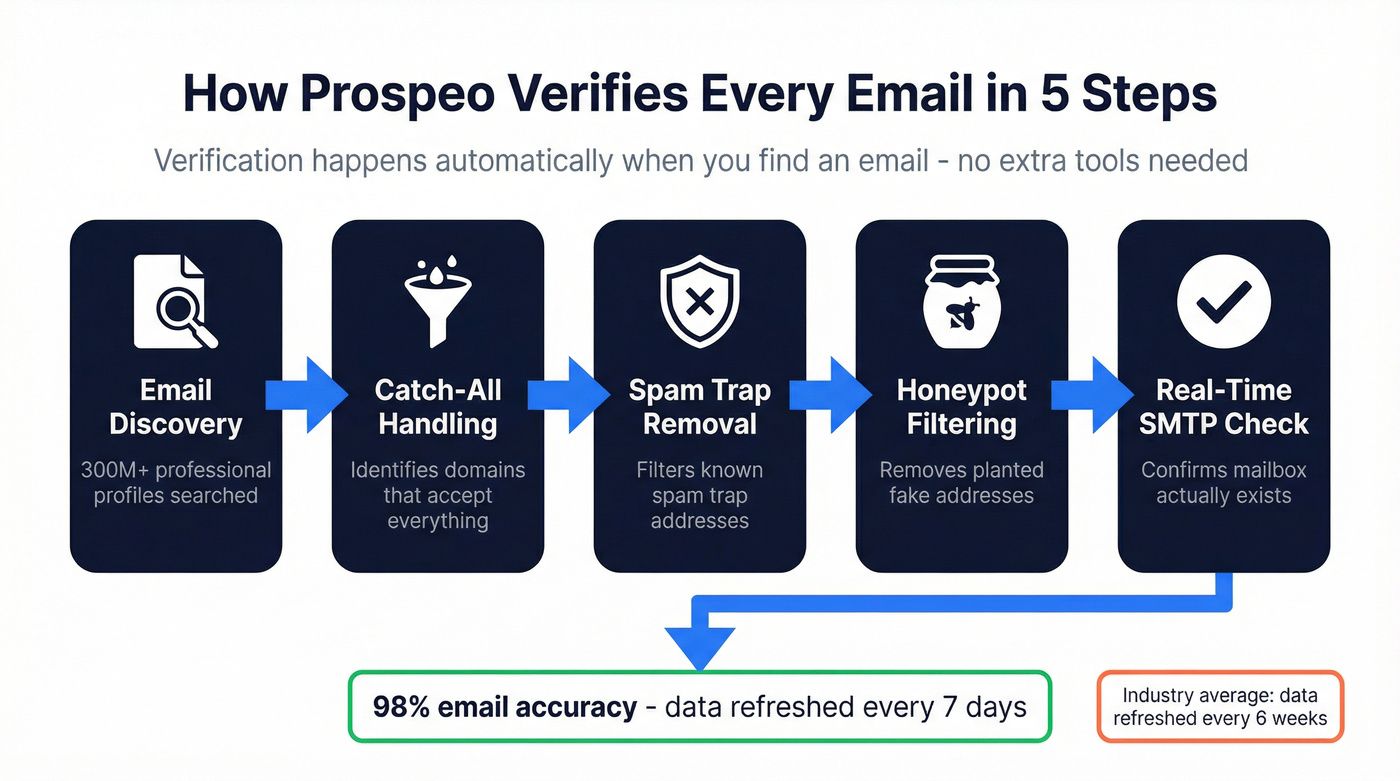
Most overviews stop at "the verifier checks the address." In practice real-time verification is a stack of checks, each with its own failure modes.
Syntax and cheap sanity checks
The first layer is mechanical. The verifier confirms the address follows the local-part@domain format, that the characters are legal, that the obvious provider typos (Gmail, Yahoo, Outlook) are caught, and that the same address has not already appeared in the batch. Most garbage never makes it past this step. A perfectly formatted address at a dead domain will sail through it untouched, which is exactly why the next layer exists.
DNS, MX, and domain reachability
Next comes the DNS lookup. The verifier asks whether the domain exists at all, whether it publishes MX records that can receive mail, and whether a usable A record is available as a fallback. New domains may not have propagated yet. Old domains can resolve but route nowhere meaningful. Slow or flaky DNS forces a timeout, which a strict verifier reports as "unknown" rather than "valid." DNS answers are a snapshot of how responsive a domain is in that second, not gospel.
SMTP probes and their messy reality
The SMTP step is the one most people think of when they ask how real-time verification works. The verifier opens a connection to the receiving mail server, simulates sending a message, and watches whether the server accepts or rejects the specific mailbox. It sounds tidy. It is not. Catch-all domains accept mail for every address, which creates classic false positives where everything looks valid and bounces emerge later. Greylisting tells the verifier to come back later, which can look like a hard rejection. Rate limits block aggressive probes. And some large providers deliberately mislead validation probes to make enumeration harder. Strong verifiers retry from different IPs, at different times, and treat the pattern across attempts as the truth.
Bulk email verification: the housekeeper
Where real-time guards the front door, bulk verification cleans the rooms behind it. Instead of checking one address at a time, you hand a verifier a CSV with thousands or even millions of records and get back a comprehensive report that flags every address as valid, risky, or removable. The same syntax, domain, MX, and SMTP layers run, this time at scale.
When bulk verification earns its keep. Data decays whether you are paying attention or not, so bulk is the routine sweep that keeps an existing list usable:
- Lists you have not emailed in three or more months
- Pre-campaign cleanses before a major holiday or product launch
- CRM migrations, where stale records corrupt the new system
- Re-engagement of dormant subscribers
- Any inherited or third-party list, where you have no history of how the addresses behave
If bounce rates climbing past 5 percent is the kind of incident that makes your week worse, bulk verification is the tool you want running on a calendar, not just in a crisis.
Real-time vs bulk at a glance
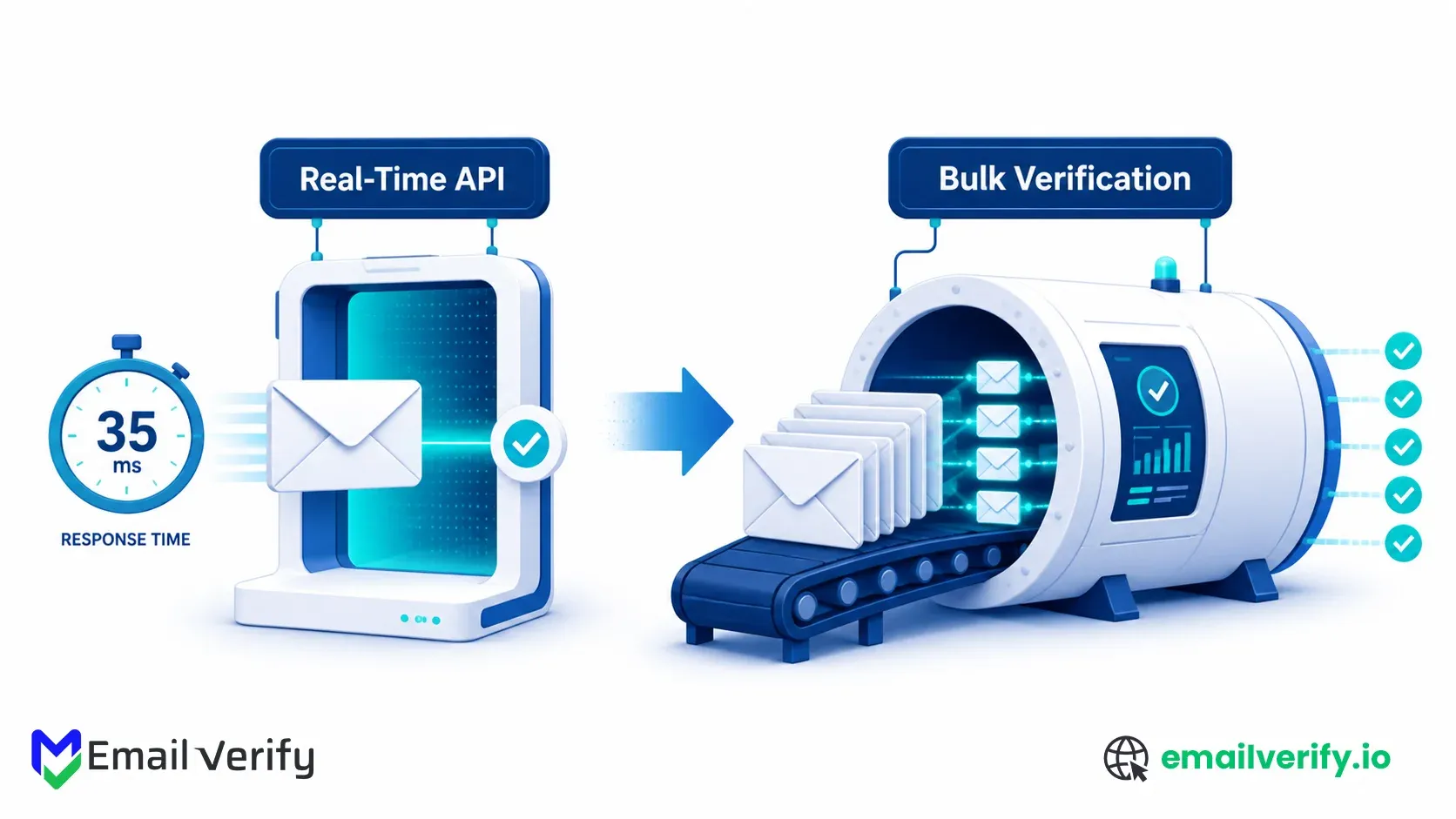
Both methods run the same underlying checks. They diverge on timing, throughput, and the question they answer.
| Real-time verification | Bulk verification | |
|---|---|---|
| When it runs | At the moment of capture | On demand, against an existing list |
| Input | One address, via API | A CSV or list of thousands to millions |
| Output | Pass, fail, or risky prompt inline | A full report flagging every record |
| Primary job | Stop bad data entering the system | Restore accuracy to data already inside it |
| Best fit | Signup forms, checkout, demo requests | Quarterly hygiene, pre-send cleanses, migrations |
| Failure mode | A single SMTP probe can lie | A snapshot ages out the moment the run finishes |
The table makes the trade-off concrete. Real-time is fast and narrow. Bulk is comprehensive but time-bound. Neither replaces the other.
When to use real-time, bulk, or both
The practical question is not which method is better in the abstract, but which one fits the workflow you are about to run.
Ecommerce. Real-time verification on signup and checkout is non-negotiable, because the receipt and the shipping confirmation have to land. Bulk verification keeps older customer lists clean for promotional and re-engagement sends.
B2B SaaS. Real-time on demo forms and product registrations protects the high-value top of the funnel. Bulk on older prospect lists keeps nurture tracks from leaking emails to dormant or invalid addresses.
CRM migrations. Bulk verification should be a standard step in any major data move. Real-time should be wired into every active lead-capture point afterwards so the new system does not start accumulating the same rot the old one did.
Cold outreach and re-engagement. Bulk is the right starting point for any list you did not collect yourself. Inherited lists, conference scrapes, and third-party data sets all need a sweep before they ever see a send. If you are still deciding which provider to run that sweep through, our roundup of the best bulk email verification services compares the field.
The case for running them in tandem
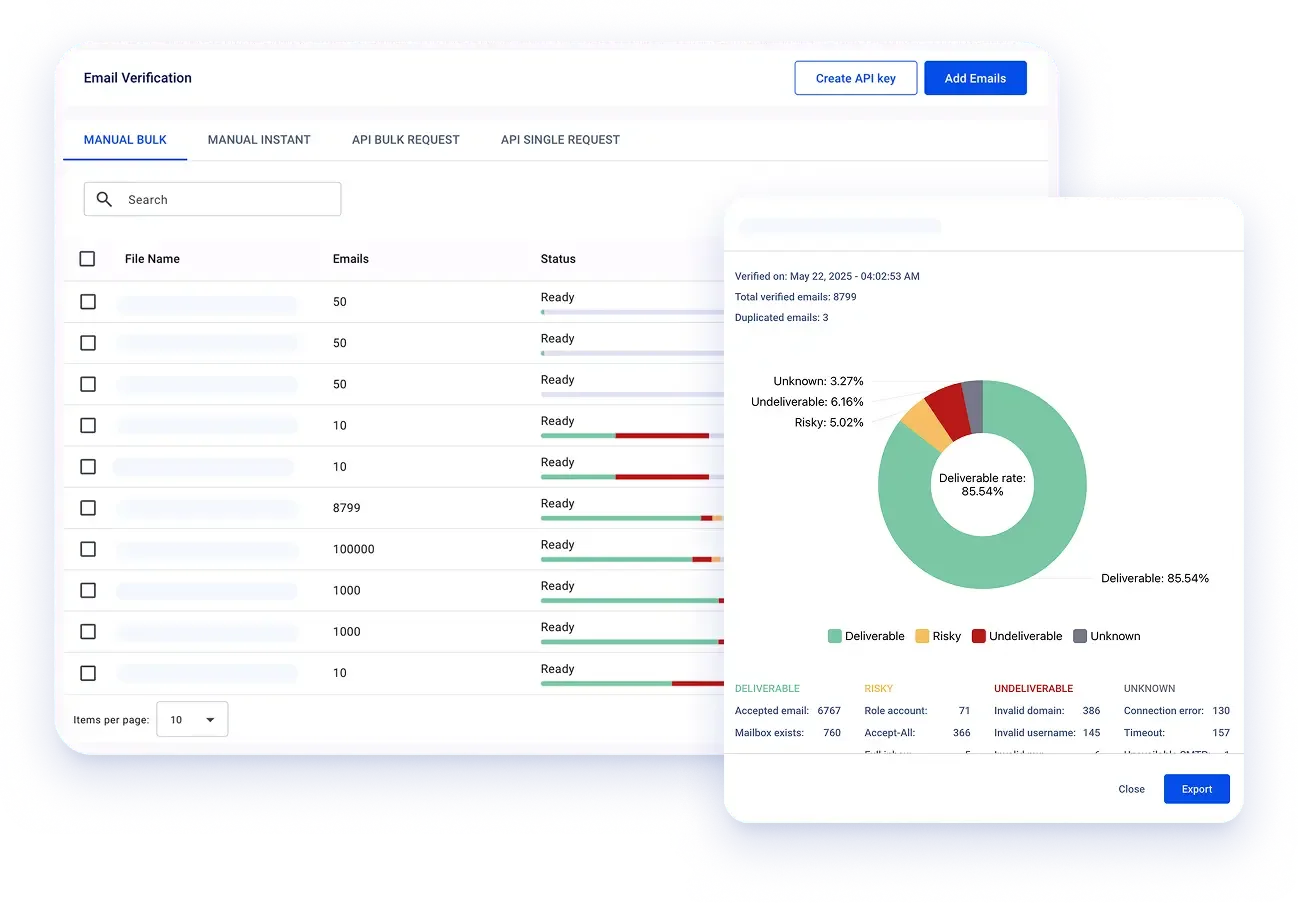
For any business sending real volume, the right answer is rarely one or the other. Real-time keeps clean data flowing in. Bulk keeps existing data from quietly going stale. Together they close the loop across the contact lifecycle, and the results show up in the campaign numbers. Validity cites the case of Reading for Education, whose inbox placement rate jumped from around 30 percent to over 95 percent after pairing real-time verification with periodic bulk cleaning, with a 200 percent lift in email-attributed revenue.
A mature verification stack tends to look like this:
- Real-time checks at every capture point, covering syntax, DNS, MX, basic SMTP, and disposable detection
- Risk classification on top of the binary result, surfacing accept-all, role-based, and disposable patterns rather than just "valid"
- Scoring and reputation models that lean on historical bounce and engagement data per domain
- Periodic bulk sweeps, at minimum quarterly, more often for large or high-stakes databases
- Campaign-level monitoring of bounces, complaints, and sender reputation signals to catch new problems early
- Feedback loops that send those outcomes back into the verification engine so future judgments improve
It is also the operational layer that determines whether the stack works. Define data quality ownership across marketing, engineering, and sales operations. Document when bulk sweeps run and who authorizes them. Treat verification partners that meet GDPR, CCPA, and SOC 2 standards as the only candidates worth shortlisting.
Quick answers about verification timing
Is real-time email verification accurate enough on its own?
Accurate enough to be indispensable at signup, not accurate enough to be your only filter. It catches obvious bad addresses, syntax mistakes, dead domains, and many disposables at the point of capture. It cannot predict long-term deliverability, spam-trap risk, or how a server will behave under load three months later.
How often should bulk verification run?
A quarterly sweep is the minimum, and monthly is reasonable if your list is large or your campaigns are high-stakes. Run an extra sweep before any major holiday push or product launch, and always run one before re-engaging a list that has been dormant for three or more months.
Why does a verified address still bounce sometimes?
Verification answers a question at one point in time. Deliverability happens later under different conditions, with different IPs, higher volume, and stricter filters. Addresses can also decay, mailboxes can fill, and dormant inboxes can convert into spam traps between the verification check and the next campaign.
Do I need both real-time and bulk if I send low volume?
If you are capturing fewer than a thousand new addresses a month and your list rarely changes, a single real-time API at signup plus an occasional bulk run is usually enough. Volume and list age, not headcount, are what justify the full stack.
Closing thoughts
Real-time and bulk verification answer different questions and protect different parts of your data. Treating either one as the whole strategy is where senders get burned. The senders who keep their inbox placement, sender score, and campaign ROI healthy are the ones who put a real-time check at every capture point, schedule bulk sweeps on a calendar, and treat the two as a single discipline rather than two products. Audit your own workflow against that pattern and you will usually find one of the two missing. Fix that gap before you ship the next campaign, and the rest of the deliverability conversation gets a lot quieter.
§ Before your next send
Find the addresses that will bounce
Verify a single address free, or upload a CSV — the free plan includes 50 checks a month, no card needed.

BounceCheck Team
The team behind BounceCheck - helping businesses verify emails and improve deliverability.