Disposable Email Detection: Static Blocklist vs. Real-Time API in 2026
Disposable email detection means identifying signup addresses that come from temporary, throwaway, or burner services, such as 10 Minute Mail or Mailinator, before they land in your database. A static blocklist, like the community-maintained disposable-email-domains GitHub project, catches the domains already known to be disposable, but it can't catch one that goes live an hour after you last downloaded the file. New throwaway domains appear daily, and the people abusing a signup form pick domains deliberately absent from public lists. In practice, a static list holds up fine under roughly 1,000 signups a month with low abuse risk; past that, or the moment an unlisted domain gets through, a real-time API is what scales.
What Counts as a Disposable Email Address
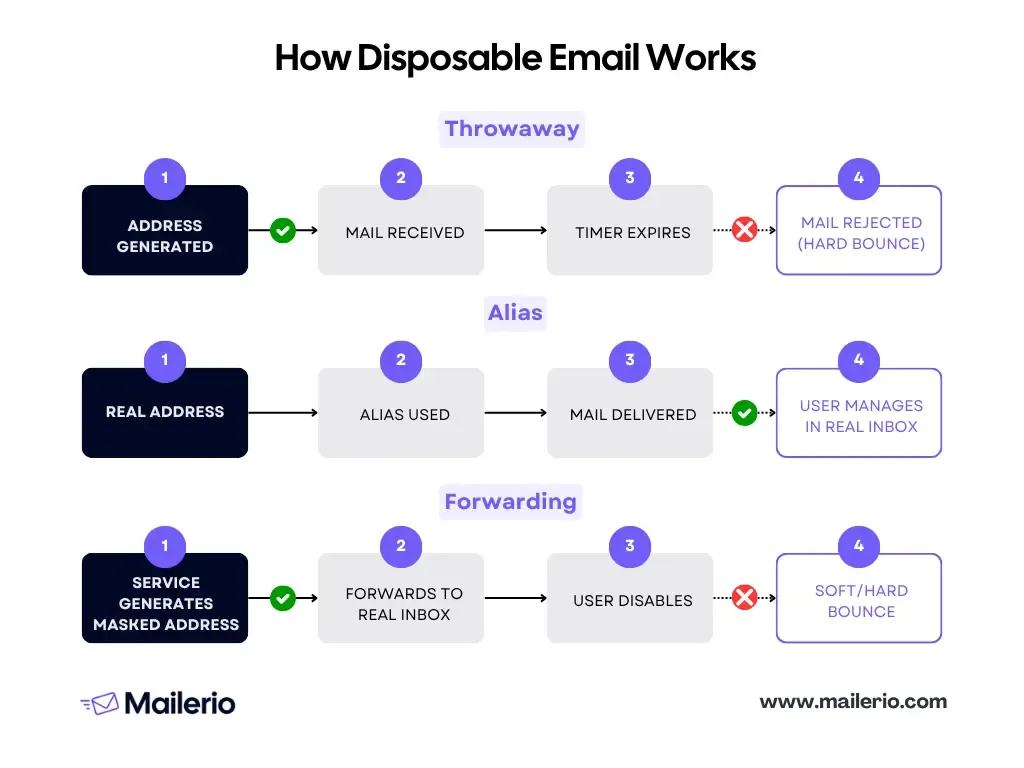
A disposable email address is a mailbox built to receive one message, or a handful, before it expires or gets abandoned. Unlike a Gmail or Yahoo address that a person keeps for years, a disposable address exists only long enough to confirm a signup, download a gated file, or claim a promo code.
- Time-limited burner addresses: 10 Minute Mail is the clearest example, an inbox that self-destructs within minutes, so there's nothing left to trace once the confirmation email lands.
- Persistent public inboxes: Mailinator and similar services publish every inbox openly, so anyone who knows or guesses the address can read mail sent to it; the address itself never expires, but nobody owns it either.
- Forwarding aliases on a custom domain: these route to a real inbox the user actually checks, which makes them the hardest of the three to catch, since the domain itself isn't inherently disposable.
Why Static Blocklists Decay
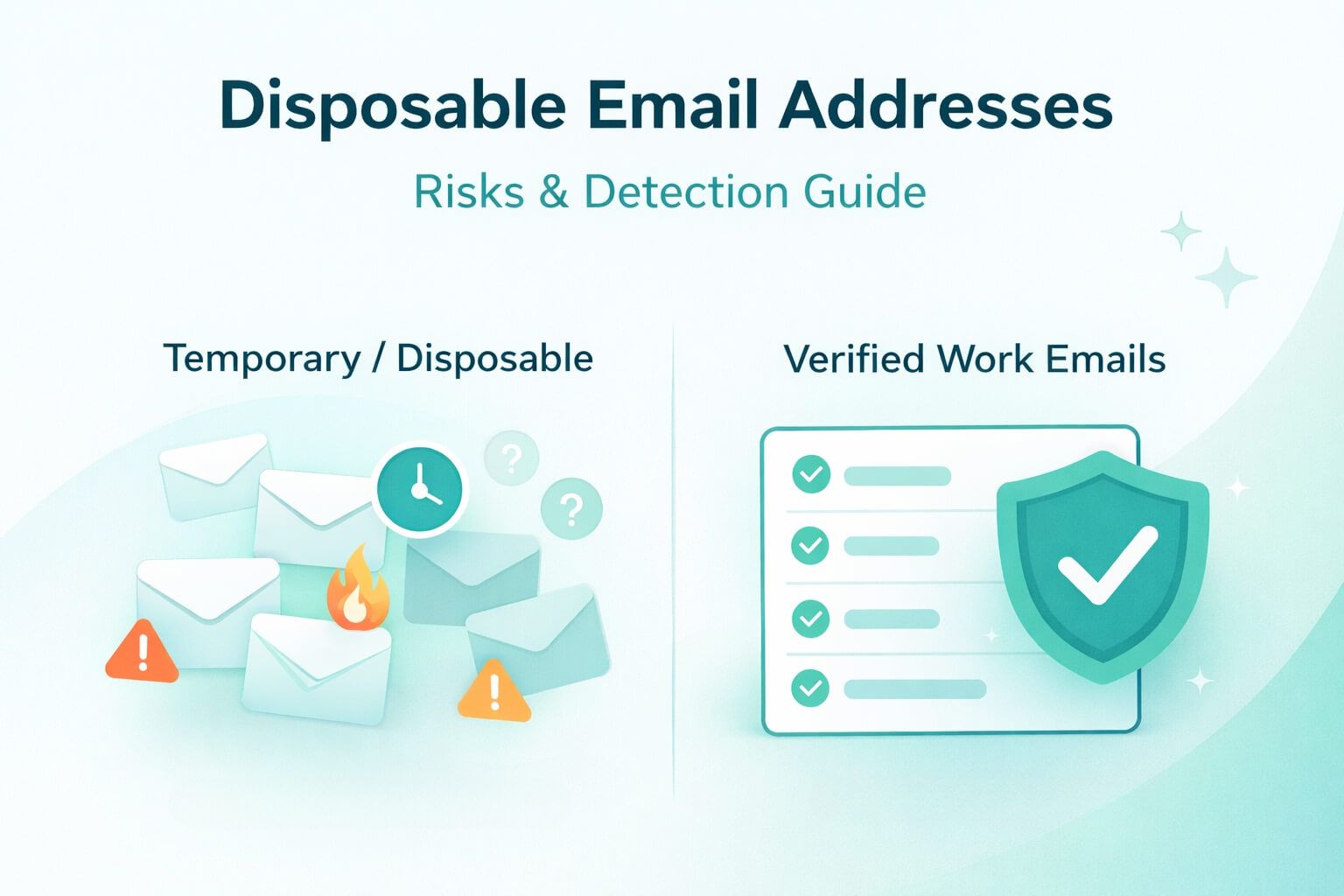
Static blocklists decay because the supply of disposable domains is never fixed. Providers register new domains faster than any list can be reviewed and republished, and the moment a domain lands on a public blocklist, its usefulness to an abuser drops to zero, so they simply move on to the next unlisted one. A list is always describing yesterday's abuse, not today's.
The scale of that churn is the part most static-list adopters underestimate. According to Abstract API's 2026 guide, new burner domains appear every hour, and BillionVerify has tracked disposable-domain providers adding new domains "sometimes hundreds per week." A downloaded copy of the disposable-email-domains GitHub blocklist is accurate on the day you pull it and progressively less accurate every day after, because the project depends on contributors noticing and submitting new domains before abusers find them first.

The pressure to close that gap isn't only about wasted signups. Mailbox providers now grade your sending reputation on how clean your list is before you ever send a campaign. Abstract API's guide puts the danger line at a hard bounce rate above roughly 0.3%, the point at which Gmail and Yahoo start reading a sender's pattern as list abuse rather than the occasional bad address. Every disposable signup that slips past your form and later hard-bounces pushes that number in the wrong direction.
None of this makes a blocklist worthless. It's cheap, instant, and correctly rejects the overwhelming majority of known offenders in a single lookup. What it can't do on its own is close the gap between "known disposable domain" and "domain that started being disposable this morning." That gap is exactly what a real-time API is built to cover, which is why the two aren't competing tools: a blocklist plus a real-time API is the only combination that scales as domain churn keeps accelerating.
How Real-Time API Detection Works
Real-time API detection runs a domain through several checks the instant someone submits a form, instead of relying on a list compiled in advance. It confirms the domain can receive mail, evaluates how the domain and its infrastructure behave, and returns a verdict, true or false, in well under a second, before the signup is even saved.
- Domain lookup against a known-disposable list: the fast first pass, the same static list, just consulted live instead of stored client-side; it still resolves most known offenders in milliseconds.
- MX record check: an MX record lookup confirms the domain has a mail server willing to accept messages at all; a domain with no MX record, or one pointing at throwaway hosting infrastructure, is a strong signal on its own.
- SMTP handshake: the API opens an SMTP conversation with the receiving server and checks how it responds, which catches domains built specifically to accept mail and then discard it, a pattern a plain MX check alone can miss.
- Pattern and behavioral analysis: domain age, registration patterns, and signup velocity from the same IP address flag brand-new domains that haven't made it onto any public list yet, which is exactly the case a static blocklist is structurally unable to catch.
This differs from email verification vs. validation in scope: verification confirms a mailbox exists and can receive mail, while disposable detection specifically flags mailboxes built on purpose to be discarded.
When a Static List Is Enough vs. When You Need an API
A static blocklist is enough when your signup volume is low and your abuse risk is low: think under roughly 1,000 signups a month, mostly organic traffic, no bot campaigns targeting your form. Once you cross that volume, see an unlisted domain get through, or need a sub-second check at the point of signup, a real-time API is the tool that scales with you.
| Situation | Static blocklist | Real-time API |
|---|---|---|
| Under ~1,000 signups/month, low abuse risk | Sufficient on its own | Optional |
| An unlisted or brand-new domain gets through | No longer sufficient | Needed |
| Over ~1,000 signups/month | Insufficient alone | Needed |
| Sub-second check required at the signup form | Can't guarantee timing | Needed |
The threshold isn't really about the size of your company; it's about how attractive your form is to abuse. A low-volume signup flow that nobody is scripting against can run on a blocklist alone for a long time. The same volume with a referral bonus, a free trial, or an API quota attached to signup draws scripted abuse fast enough that the blocklist's lag becomes the whole story.
Can Disposable Emails Be Traced?
No, not by the sender, and rarely by anyone else without legal process. A disposable address is designed to have no owner attached: providers like 10 Minute Mail and Mailinator don't verify who requests an inbox, and most don't retain logs long enough to matter even if they wanted to cooperate.
Using a disposable email address is legal; blocking one at signup is a business policy decision, not a legal one. Tracing generally requires a subpoena served on the provider itself, and many disposable services are built specifically to have nothing worth subpoenaing: no billing record, no verified phone number, no persistent account. That's why detection happens before the send, at the point of signup, rather than after the fact. Once a disposable address has already consumed a free trial or skewed your open rate, there's no traceback that gets that value back.
The practical response isn't investigation, it's prevention: catching the address at the form with a blocklist, an API, or both, before it ever reaches your list.
FAQ
Is it illegal to use a disposable email address? No. Using a disposable address is legal in virtually every jurisdiction; whether to allow one at signup is a policy call for the business receiving it, not a legal restriction on the person sending it.
Does Gmail count as a disposable email address? No. A standard Gmail or Yahoo mailbox is a mailbox provider address a person maintains indefinitely. Gmail's own sub-addressing feature ([email protected]) isn't disposable either, though it can signal a low-intent or automated signup and is usually handled by stripping the +suffix before matching.
How do I detect a disposable email for free? Pull the disposable-email-domains GitHub blocklist and check incoming domains against it in your signup handler. It costs nothing and catches most known offenders, but it decays daily and won't catch a domain that isn't on the list yet.
Can a disposable email address receive replies? Time-limited services like 10 Minute Mail can, but only until the inbox expires, sometimes within minutes. Persistent public inboxes like Mailinator can receive replies indefinitely, but since anyone can read a public Mailinator inbox, there's no privacy guarantee for whatever gets sent back.