Email Verification vs. Validation: The Difference That Actually Prevents Bounces in 2026#
Email Verification vs. Validation: The Difference That Actually Prevents Bounces in 2026
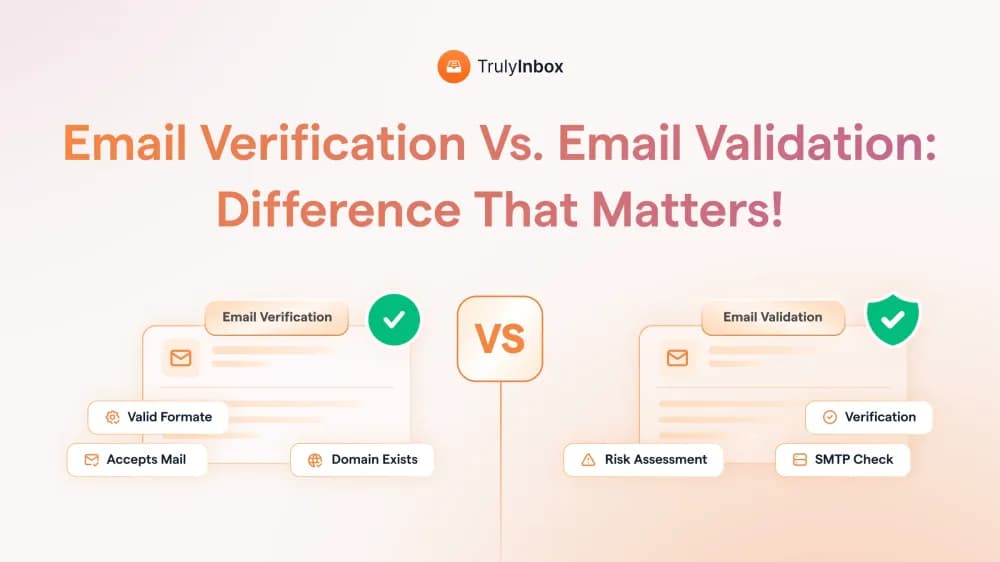
Email validation checks whether an address could exist: correct syntax, a real domain, RFC-compliant formatting. Email verification checks whether it does exist: MX records, a live SMTP handshake, and confirmation that a mailbox can currently receive mail. That could-exist-versus-does-exist line, not the terminology, is what determines whether a "clean" list still produces hard bounces. Validation belongs on your signup form. Verification belongs right before you send, and again during periodic list hygiene.
What email validation checks
Email validation analyzes an address's structure: allowed characters, correct formatting, the domain, and RFC compliance. It typically runs three checks: syntax analysis (does the string look like an email address), domain analysis (does the domain resolve), and address-type analysis, which tries to flag temporary, junk, or disposable addresses. Some validators also attempt spamtrap detection at this stage, but treat that claim skeptically: validators cannot reliably identify spamtraps, since a spamtrap is designed to look exactly like a normal inactive address. Real protection against spamtraps comes from list hygiene and never buying or renting lists, not from a validation pass.
Validation catches typos and malformed addresses before they ever enter your database. What it cannot do is confirm the address is real, active, or actually deliverable. A syntactically perfect address at a domain with no working mailbox will pass validation and still bounce. See the anatomy of an email address for how each of these parts maps to the checks a validator runs, and RFC 5322 for the formatting standard validators check against.
What email verification checks
Verification goes further: it interacts with the receiving mail server to confirm the mailbox is active. That means checking for MX records (no MX record means the domain cannot receive mail at all, so any address on it is invalid), opening an SMTP session, and running an SMTP-level check against the specific mailbox. Accept-all (catch-all) domains complicate this: they accept all incoming mail even when a specific mailbox doesn't exist, so an "accept-all" result still carries bounce risk and shouldn't be treated as a clean pass. If the receiving server blocks the verification attempt, the result comes back "blocked" rather than confirmed, which is a different outcome from "deliverable." For background on the protocol doing this handshake, see what SMTP is.
Verification, run properly before a send, can bring hard bounce rates close to zero. It's still not a guarantee: some mail servers reject verification requests outright, so even a fully verified list won't hit 100% accuracy. That's the honest limit of verification, not a flaw specific to any one tool.
Validation vs. verification: the essential differences
| Email validation | Email verification | |
|---|---|---|
| Scope | Format, syntax, domain existence, RFC compliance | Mailbox existence and current deliverability |
| Check method | Syntax analysis, domain analysis, address-type analysis | MX record lookup, SMTP handshake, accept-all detection |
| Timing | At data collection (signup, opt-in forms) | Before every send, and during periodic list maintenance |
| What it catches | Typos, malformed addresses, dead domains | Inactive mailboxes, misconfigured servers, catch-all risk |
| What it misses | Whether the mailbox is real or receiving mail | Servers that block or reject verification requests |
Which comes first: validation at signup, verification before you send
Validation and verification solve different problems at different points in the pipeline. Put validation on the signup form itself: it stops obvious typos and malformed addresses in real time, with less friction than a CAPTCHA. Run verification separately, right before a campaign goes out, and again as part of regular list-maintenance cycles, especially on older or inherited lists you didn't build with real-time validation in the first place. A hard bounce rate above 2% tells Gmail your list is stale; that's the outcome verification is meant to catch before it happens, not after.
Tools like NeverBounce, Hunter, Bouncer, and ZeroBounce all run some version of this verification pass, with differences in coverage and pricing. BounceCheck runs real-time and bulk verification through a stealth SMTP engine, with credits that never expire and a $9.99 entry point, plus an API for pipeline integration. That's one lever in a bigger deliverability picture, not the whole fix: verification removes invalid addresses, but it won't repair a sender reputation that's already damaged, and it won't replace the authentication requirements (SPF, DKIM, DMARC) that Gmail and Yahoo now enforce on bulk senders, alongside spam complaint rates kept under 0.3%.

If you're maintaining a legacy list, periodic verification pairs well with a broader CRM data cleaning pass, since stale addresses tend to cluster with other stale contact data. And when a send does bounce despite verification, understanding what a bounced email actually means helps you decide whether to remove the address or investigate the source that produced it.
FAQs
What is the difference between email validation and verification?
Validation confirms an address is correctly formatted and points to a real domain. Verification confirms the specific mailbox exists and can currently receive mail, by checking MX records and running an SMTP-level check against the server. Validation tells you an address could exist; verification tells you it does.
Which comes first, validation or verification?
Validation runs at data collection, typically on the signup or opt-in form, where it catches typos and malformed addresses in real time. Verification runs later: right before a campaign send, and again on a recurring schedule for list hygiene, particularly on older lists that weren't validated at the point of collection.
Which is more important, validation or verification?
Both are necessary, but verification is the higher-stakes gate right before a send. Validation alone cannot prevent hard bounces, since it can't confirm a mailbox is actually active. Verification is what directly protects your hard bounce rate and sender reputation at send time.
What is the point of email verification?
Verification exists to keep hard bounce rates down and protect sender reputation and deliverability. Addresses that are properly verified before a send can bring hard bounce rates close to zero, which matters because mailbox providers throttle or spam-foliate senders with high bounce rates.
Can verification catch spamtraps?
Not reliably. Validation and verification tools are not built to reliably detect spamtraps, since a spamtrap is designed to behave like a normal address. The real defense against spamtraps is list hygiene: never buy or rent lists, and remove addresses with no recent engagement.
Run your list through BounceCheck before your next send.