How Many Follow-Ups Before Giving Up? The Cold Email Cadence That Actually Works
 BounceCheck Team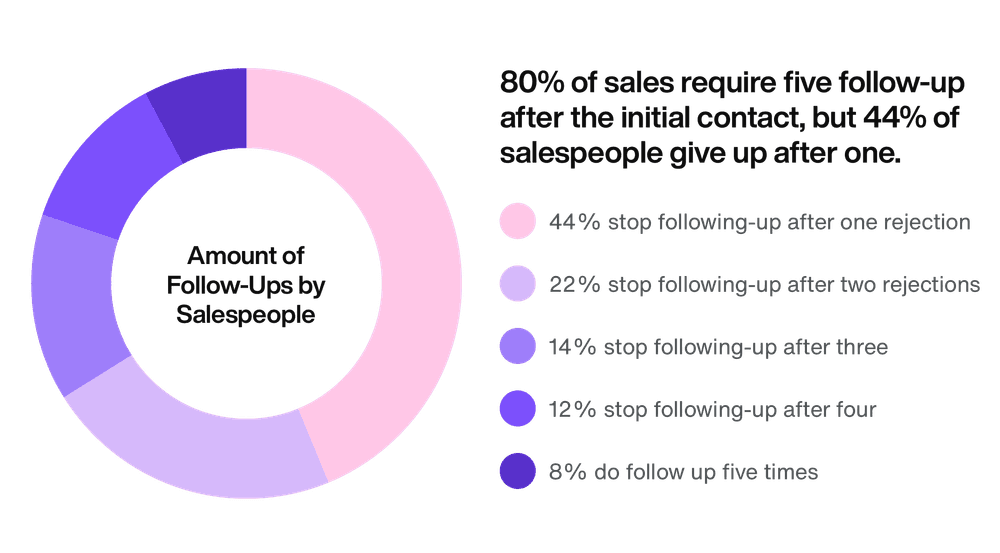
Most sales reps quit cold-email follow-ups long before the prospect was going to reply. The data backs that up so often it has become folk wisdom in outbound circles: 44% of reps give up after the first follow-up, while 80% of non-routine sales close only after at least five touches. The gap between those two numbers is where most pipeline goes to die.
This guide walks through the optimal number of follow-ups for cold email, how to space them, what each touch should actually say, and the signal that tells you it is time to send the break-up email and move on. Think of it as the practical layer that sits on top of any outreach framework you already use.
The data: how many touches it actually takes
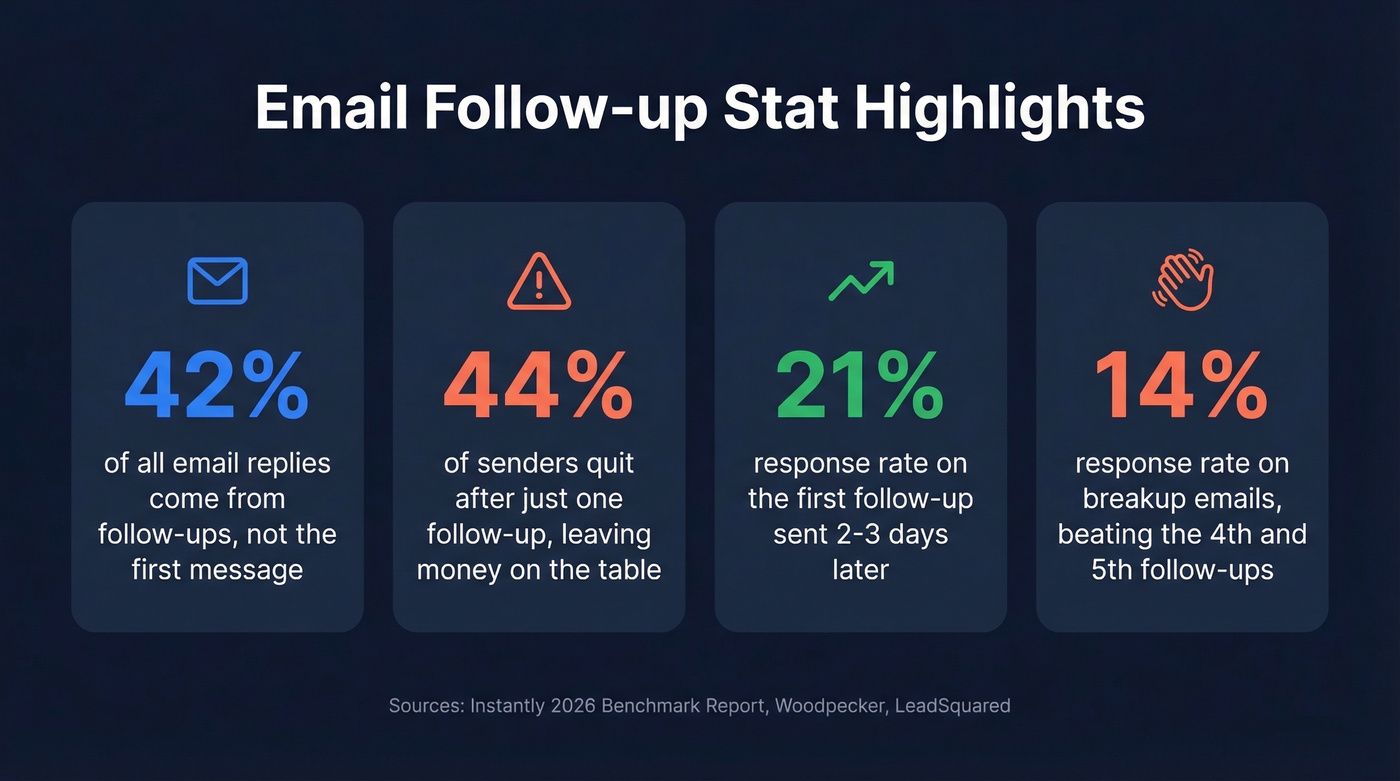
The headline number is 5 to 8. Most well-performing B2B sales cadences land somewhere in that range over 2 to 4 weeks. Below 5 and you are leaving deals on the table. Above 8 and the marginal value per touch falls off a cliff while deliverability risk climbs.
The stats that drive this are uncomfortable but consistent:
- 80% of non-routine sales close only after at least 5 follow-ups (Peak Sales Recruiting).
- 60% of customers say no four times before saying yes (Invesp).
- 92% of reps give up after the fourth call (IRC Sales Solutions).
- 48% of salespeople never make a follow-up attempt at all.
- 44% give up after the first follow-up.
- Only 8% of reps follow up more than 5 times. That same 8% is who closes most of the late-cycle deals.
- A Backlinko study of 12 million emails put the average cold-email reply rate at 8.5%, and a single follow-up lifts replies by 65.8%.
You can argue with the exact percentages, but every dataset points to the same conclusion: persistence past the first three or four touches is where most response and revenue actually live. That is also why open-rate benchmarks alone are a misleading way to judge a campaign. A 30% open rate on touch one means nothing if you bail before touch five.
Why most reps quit too early
The reason is psychological, not strategic. When you send a second or third email and no reply comes back, the brain assumes the prospect hates you. Psychologists call this the spotlight effect: we overestimate how much other people are paying attention to us. In reality, your follow-up got two seconds of attention, or none at all, because the prospect was deep in a product launch, a budget review, or a hiring crisis the day it landed.
The recipient is not judging you. They are overloaded. Treating every silent inbox as a personal rejection is what kills cadences. Reps who win at scale stop running follow-ups on feeling and start running them as a system. The mere exposure effect (familiarity builds preference) and recency bias (the last message in mind gets the meeting) both work in your favor, but only if you stay in the inbox long enough for them to kick in.
The optimal follow-up cadence (day by day)
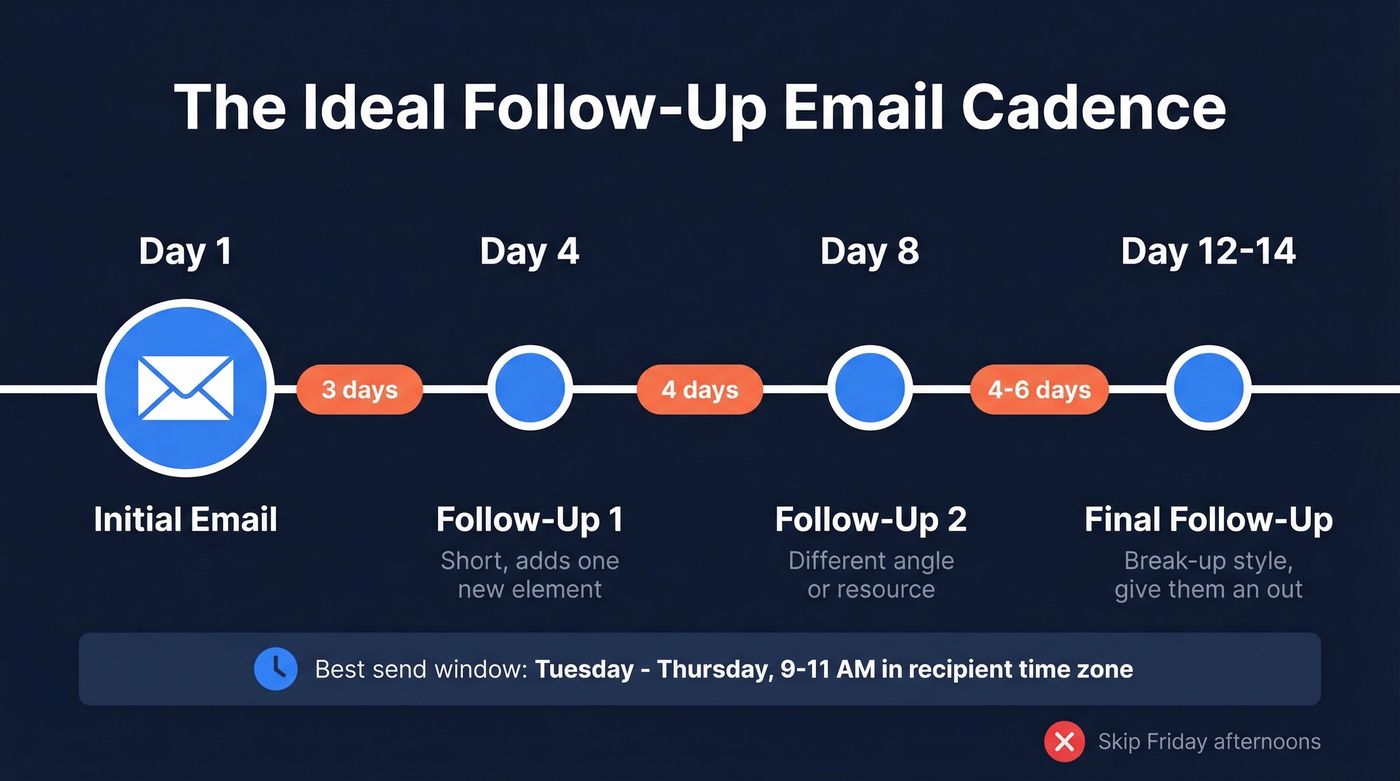
There are two well-tested cadence shapes worth copying. The first comes from a Yesware analysis of reps who actually got replies versus reps who did not:
- Day 3: first follow-up
- Day 7: second follow-up
- Day 11: third follow-up
- Day 15: fourth follow-up
- Day 19: fifth follow-up
- Day 22: final / break-up
The second shape is a 5-step pattern weighted toward the front of the sequence:
- Day 1: initial email (short, clear ask)
- Day 3: follow-up referencing the first email, adding new insight
- Day 6: case study or concrete result
- Day 12: objection-handling touch (video or screenshot)
- Day 24: break-up email with door left open
The two patterns share the same logic. Front-load the touches when memory is fresh (2 to 3 days apart for steps 1 to 3), then stretch later touches to 4 to 7 days so the inbox does not feel harassed. Spacing past 4 days per touch in the early stretch consistently underperforms in Yesware's data, while jamming touches closer than 2 days apart starts to look like a spam pattern to mailbox filters.
The first follow-up matters more than people think. Harvard Business Review research found you are 7 times more likely to have a meaningful conversation if you respond within an hour of an inbound signal. Automating that first touch with a sequence tool is one of the highest-leverage moves you can make.
What to write in each follow-up

Every touch has to give the prospect a reason to engage that is not guilt. The cadence above only works if the content varies. Recycling the same email five times is the fastest way to get muted.
Touch 2: Polite re-surface
- Thank them for any earlier interaction, even if it was just opening a form.
- Acknowledge they are probably busy.
- Restate the value in one sentence, not three.
- Restate the proposed next step (15-minute call, demo, free trial).
Touch 3: New angle
- Share a case study or a concrete result that mirrors their situation.
- Add a single new data point or insight they did not see in touches 1 and 2.
- Keep it under 125 words. Research from Boomerang shows emails between 50 and 125 words outperform longer ones for reply rate.
Touch 4: Objection handling
- Address the silent objection head-on ("most teams worry that X, here is how we solve it").
- Offer a low-friction asset (a short video, a calculator, a one-page brief).
- Avoid passive-aggressive lines like "did you see my last email?" Buyers say in surveys they are less likely to buy from anyone applying pressure.
Touch 5: Break-up
- Recognise this is your final attempt.
- Close the loop without guilt-tripping.
- Leave a clear path back ("if priorities change, just reply").
These are templates, not scripts. Personalisation still matters: emails with proper merge fields and a real reference to the prospect's context can double reply rate, while broken merge fields ("Dear [NAME]") do worse than no personalisation at all. If you want the longer guide on building each touch from scratch, the cold-email copywriting framework has the prompts and templates.
Sales follow-ups vs interview follow-ups
The cadence advice in this article is built for B2B sales outreach, where you initiated the conversation. If you are following up on a job interview, the math flips. They initiated, which means a heavy cadence reads as desperation rather than persistence.
| Context | Frequency | Tone | When to stop |
|---|---|---|---|
| B2B sales outreach | 5 to 8 touches over 2 to 4 weeks | Professional, value-driven, problem-solving | After 15 to 24 days with a polite break-up email |
| Job interview | 1 to 3 touches over 1 to 2 weeks | Appreciative, reaffirming interest, concise | After the final decision is communicated, or after 4 to 5 weeks of silence |
For the interview case specifically: send a thank-you note within 24 hours, wait at least one full week between follow-ups after that, and if four to five weeks pass with no reply, the role is filled or paused. Move on.
When to send the break-up email and stop
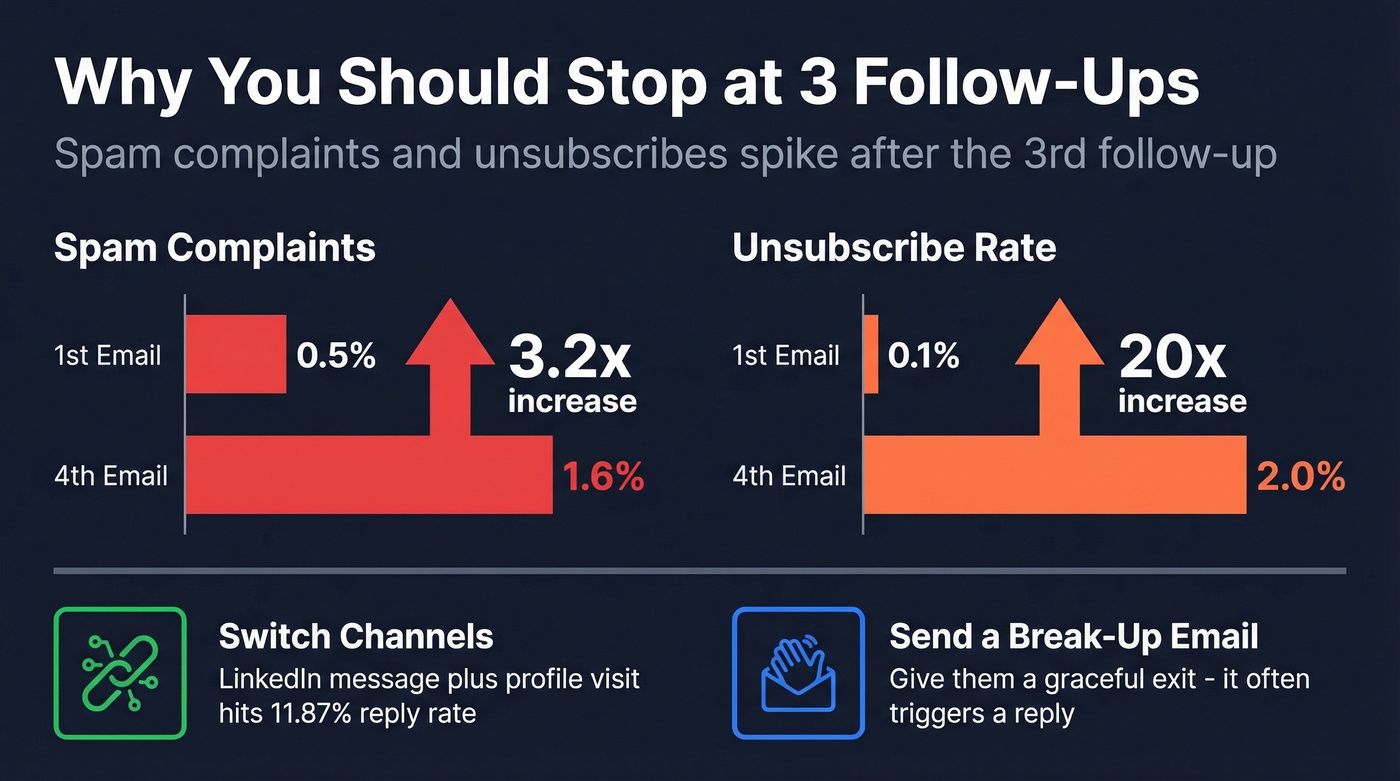
The break-up email is not surrender. Done well, it is the highest-converting touch in the entire sequence because it removes the pressure that kept the prospect quiet.
You know it is time when you have reached or exceeded your usual cadence (touch 5 to 8) and you have received either no reply at all or only non-committal answers from people low in the decision-making chain. At that point a good break-up email accomplishes three things:
- Respects their time. You acknowledge they are not ready, instead of pretending you did not notice.
- Leaves the door open. Prospects often reply to break-up emails precisely because the pressure is off.
- Protects your sender reputation. Continuing past touch 8 against a silent inbox drives complaint rates up and feeds reputation systems with the wrong signal. That is the same risk that hits when your domains are sending without a proper warm-up flow under them.
A simple format works: state that you have not heard back, assume the timing is wrong, close the loop, leave a one-line invitation back. No guilt, no recap, no second pitch. Around 200 to 500 characters is enough.
A few rules apply regardless of which break-up wording you use. Cap daily sends at roughly 30 per inbox, rotate copy variations across accounts so mailbox providers do not see identical strings, and respect the basic legal floor: under the CAN-SPAM Act you need accurate headers, an honest subject line, and a working unsubscribe path. The Act does not cap follow-up frequency, but it caps how careless you are allowed to be about it. GDPR adds an explicit opt-out requirement on top for EU recipients.
After the break-up lands and 24 to 48 hours pass with no reply, recycle the lead to a 90-day nurture list. Re-engaging the same address from the same domain a week later is the fastest way to get blocked.
Persistence without a system is just noise
The gap between 44% of reps quitting after one touch and 80% of deals closing after five is a competitive advantage, but only if you treat follow-ups as infrastructure rather than willpower. Spreadsheets do not survive contact with 30 active prospects. Memory does not survive at all.
A working follow-up program needs three pieces in place: a documented cadence (the day-by-day pattern above), a content plan for each touch (so you are not retyping the same message), and an automated sequencer that pauses on reply. If any of the three is missing, the cadence collapses back to send-and-hope. Pair that with reasonable bounce rates, a clean list, and the data starts working in your favor instead of against it.
The right number of follow-ups before giving up is not a single number. It is whatever number lets a disciplined sequence run to its scheduled break-up email without panic or drift. For most B2B cold-email programs, that lands between 5 and 8.

BounceCheck Team
The team behind BounceCheck - helping businesses verify emails and improve deliverability.