Email Verification API: How It Works and How to Choose One
 BounceCheck Team
An email verification API is a service you call from code to check, in real time, whether an email address is valid, deliverable, and safe to send before it enters your system. It runs syntax, DNS or MX, and SMTP mailbox checks in milliseconds and returns a structured result your application can act on. For any signup form, lead capture, or CRM import, that means catching mistyped, fake, and abandoned addresses at the source instead of discovering them weeks later as hard bounces.
This guide explains what an email verification API does, how the checks work under the hood, what a typical response looks like, and how to pick a provider that fits your stack.
What is an email verification API?
An email verification API lets you programmatically check whether an email address is valid, deliverable, and safe to send. It integrates directly into your application or backend, so you can validate an address during signup, a form submission, or a CRM import and get a structured JSON response back in milliseconds.
That response tells you whether the address is valid, invalid, risky, disposable, a catch-all, or role based, usually as a status plus a more detailed sub_status. Because the check happens through code rather than a manual lookup, you can verify a single address in real time or push millions of them through the same endpoint.
How an email verification API works
Behind a single API call, a verification service runs a sequence of checks. Most providers move through three core layers, from the cheapest to the most demanding:
- Syntax validation: the address is checked for typos and compliance with the RFC 5322 standard. Addresses missing a domain or an @ symbol, or containing invalid characters and whitespace, are rejected here before any network call is made.
- MX record verification: MX records are the DNS records that route mail for a domain. The API confirms they exist and are configured correctly, because mail sent to a domain with no valid MX records will bounce.
- SMTP mailbox check: the service pings the receiving mail server to confirm the specific mailbox exists and is ready to accept mail. This is the most complex and risky step, so providers use safeguards to query servers without getting blocked or returning inaccurate results.
On top of those layers, the API compares the domain against constantly updated blocklists of disposable and temporary providers, flags role based addresses like info@ or sales@, and recognizes known spam traps. If you want the full picture of each stage, our breakdown of how verification works goes layer by layer.
What an email verification API returns
The value of an API is in its response. Rather than a simple yes or no, a modern verification endpoint returns a structured object you can branch on in code. A trimmed response looks like this:
{
  "email_address": "[email protected]",
  "status": "deliverable",
  "sub_status": "valid_email",
  "is_format_valid": true,
  "is_mx_valid": true,
  "is_smtp_valid": true,
  "is_disposable": false,
  "is_catchall": false,
  "is_role": false,
  "score": 0.92
}
The fields you will act on most often are:
- status and sub_status: the headline verdict (deliverable, undeliverable, risky, or unknown) plus a reason code you can log or display.
- is_format_valid, is_mx_valid, is_smtp_valid: the three booleans that map directly to the syntax, MX, and SMTP layers above.
- is_disposable, is_catchall, is_role: quality flags that let you block temporary inboxes, treat accept-all domains with caution, and route role based addresses differently.
- score: a confidence number many providers add so you can set your own threshold for what counts as good enough to send.
Real-time vs bulk verification
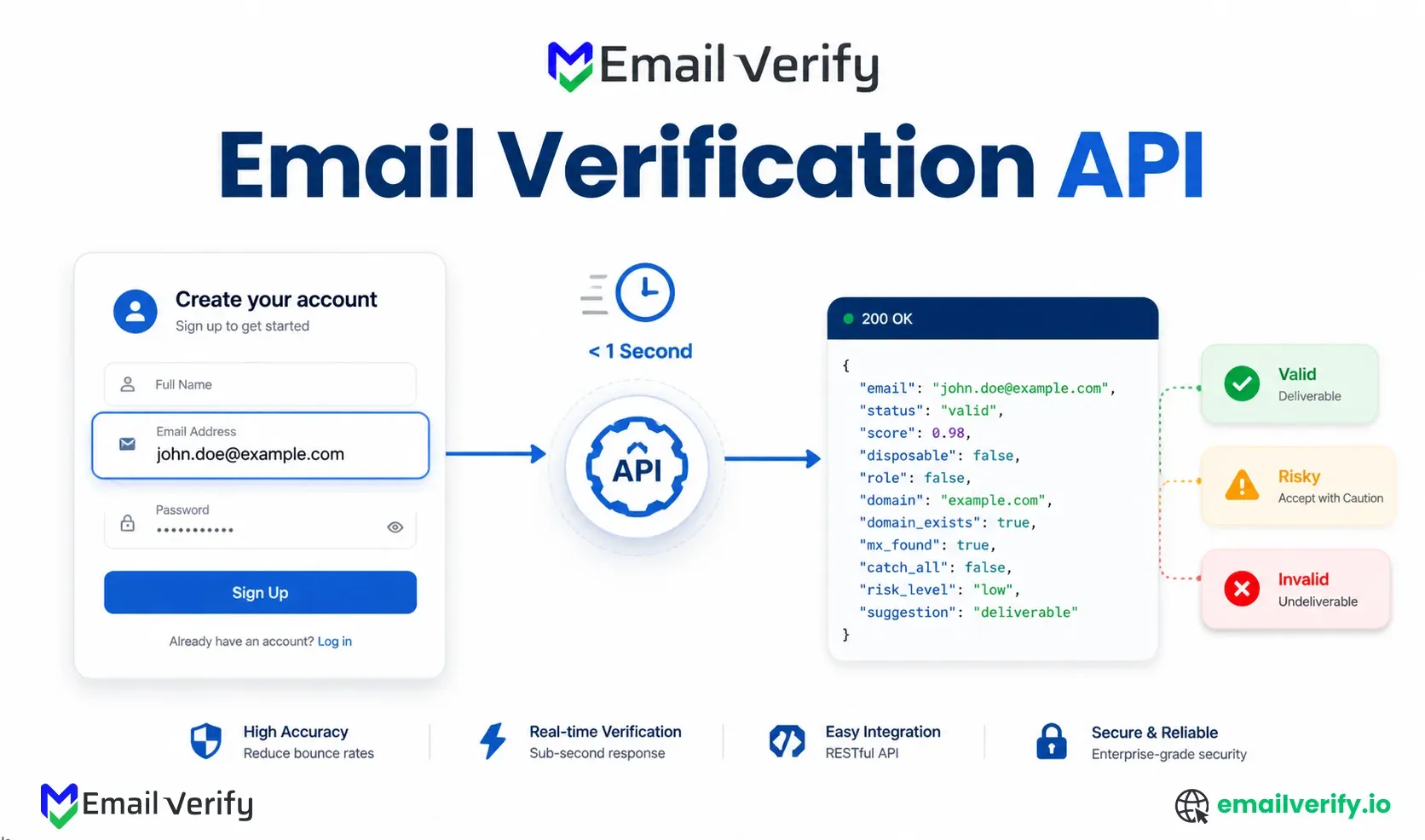
Most APIs expose the same checks through two modes, and good integrations use both. Real-time verification handles a single address synchronously, which is what you want on a signup or lead form where a person is waiting for a response. Bulk verification accepts a batch (often several thousand addresses at once), returns a task_id, and lets you poll for categorized results asynchronously, which suits cleaning an existing list before a campaign.
| Mode | Best for | How it works | Speed |
|---|---|---|---|
| Real-time | Signup forms, lead capture, live API calls | One address per request, synchronous response | Sub-second |
| Bulk | List cleaning, CRM imports, pre-campaign hygiene | Submit a batch, get a task_id, poll for results | Minutes to hours |
The right choice depends on the job, and our guide to real-time vs bulk covers where each one pays off. If you mainly need to scrub large lists, a dedicated bulk verification service is usually the better fit.
How to choose an email verification API
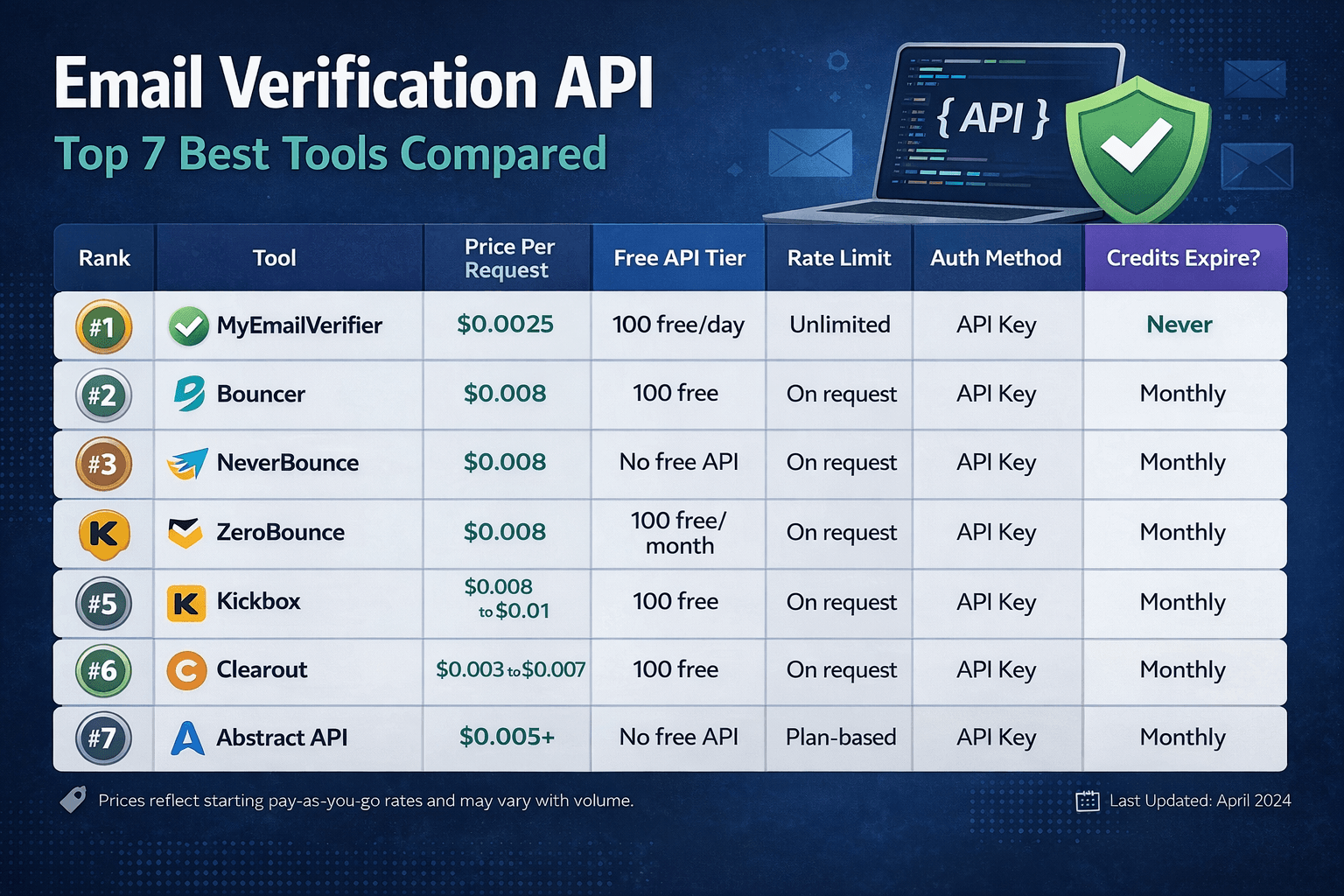
Providers vary widely on accuracy, speed, and price, so weigh them against a few criteria rather than the headline accuracy number alone:
- Capabilities: does it offer both real-time and bulk verification through one account?
- Reliability: can it catch fake and temporary addresses without flagging real users as invalid?
- Developer experience: is the API well documented, with SDKs for your language and clear status codes?
- Pricing and scalability: is there a free tier to test with, and does the cost scale predictably as volume grows?
- Compliance and privacy: for regulated data, look for SOC 2, GDPR, or HIPAA support and a policy that does not store the addresses you submit.
Free tiers and per-verification pricing differ a lot between the best known providers:
| Provider | Free tier | Price per verification |
|---|---|---|
| Emailable | 250 verifications | $0.0021 to $0.0076 |
| ZeroBounce | 100 verifications | $0.00225 to $0.009 |
| NeverBounce | 10 verifications | $0.002 to $0.008 |
| Kickbox | 100 verifications | $0.004 to $0.01 |
| Bouncer | 100 verifications | $0.0020 to $0.0080 |
If you already track deliverability with BounceCheck, its verification API runs the same syntax, MX, SMTP, and disposable checks against the workflow you use for bounce monitoring, so signup validation and list hygiene live in one place.
Common use cases
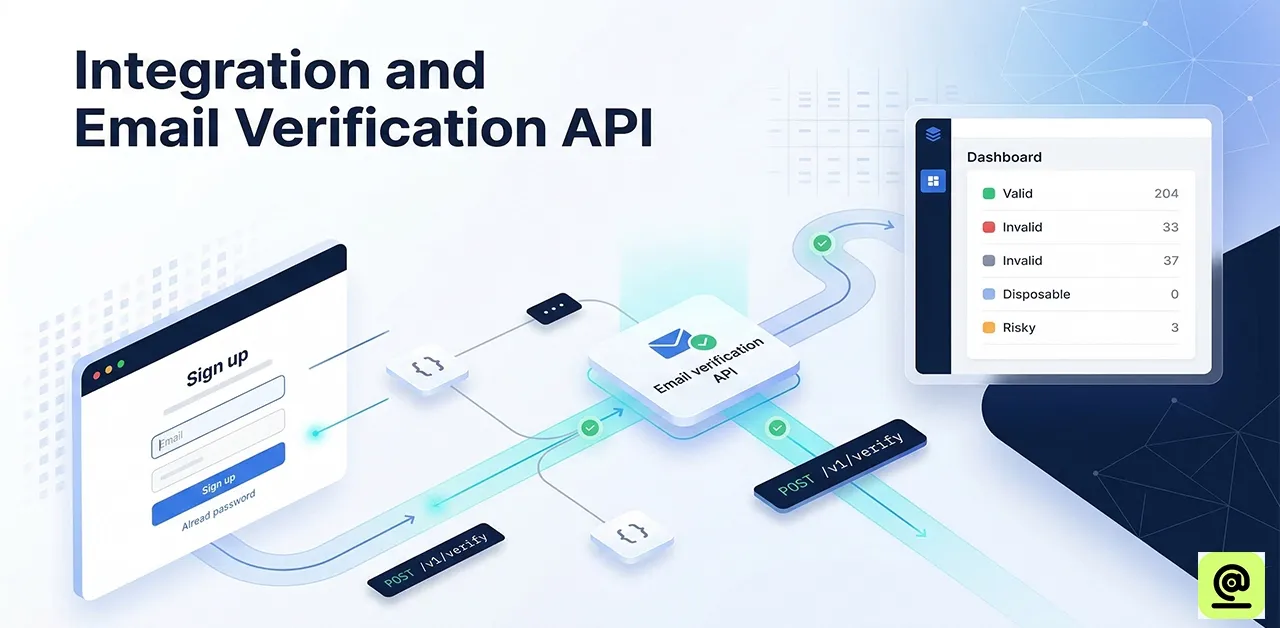
The same endpoint solves several problems across a product and a marketing stack:
- Block fake signups and bots: reject disposable, role based, and catch-all addresses before they create accounts or burn free-trial capacity.
- Clean existing lists: bulk validate a CRM export or marketing list to remove addresses that have gone stale since they were collected.
- Protect sender reputation: stop sending to invalid addresses so your bounce rate stays low and your mail keeps landing in the inbox.
- Improve lead quality: flag mistyped or low-quality addresses on lead forms so sales does not chase dead contacts.
You do not always need to write integration code. No-code platforms can call a verification step inside an automation with Zapier or Make, filtering bad leads out before they reach your CRM.
Where email verification stops, and what to pair it with
An email verification API lowers bounce rates and protects your sender reputation, but no service is 100 percent accurate. Catch-all domains accept everything, and some mailboxes simply cannot be confirmed without sending. The strongest setups treat verification as one layer among several: add a CAPTCHA to signup forms, confirm intent with a double opt-in email, and re-verify your list periodically rather than once. If you would rather avoid the risky SMTP step entirely on certain addresses, there are ways to verify an address without sending that trade a little certainty for safety. Used together, these methods give you cleaner data and more reliable delivery than verification alone.
Email verification API FAQ
Is an email verification API the same as email validation?
The terms are used interchangeably. Validation usually refers to the syntax and format check, while verification implies the deeper MX and SMTP checks that confirm a mailbox can actually receive mail. Most APIs do both and return them in a single response.
Can I build my own email verification instead of using an API?
It is technically possible, but it is rarely worth it. Rolling your own means maintaining disposable-domain blocklists, handling SMTP safeguards so you do not get blocked, and covering a long list of edge cases. A dedicated API absorbs that complexity and keeps it current for you.
How accurate is an email verification API?
Leading providers claim up to 99 percent accuracy by combining syntax, DNS, SMTP, disposable detection, and spam-trap analysis. Accuracy is never absolute, though, especially on catch-all domains, which is why pairing verification with a confirmation email is recommended.
Is there a free email verification API?
Most providers offer a free tier so you can test before paying, ranging from around 10 verifications to a few hundred per month. Free tiers are fine for evaluation and low volume, but high-volume signup validation or list cleaning will need a paid plan.

BounceCheck Team
The team behind BounceCheck - helping businesses verify emails and improve deliverability.