Google Workspace vs Microsoft 365 for Cold Email: Which One Actually Lands in the Inbox
 BounceCheck Team
Before your next send Find the addresses that will bounce.
Verify an email freeBoth platforms can send cold email well. Neither was built for it. The real question is which one fits the audience you are trying to reach and how much technical lift your team can absorb on setup. We compared inbox placement, sending limits, authentication, warmup time, and pricing across the two providers, then layered in the framework most experienced cold email operators land on after running both for a year.
The short answer, by audience
Who you are emailing matters more than which logo is on the dashboard. Both providers require SPF, DKIM, and DMARC to deliver at all, and both throttle cold senders the moment volume looks unnatural. The difference shows up in where your messages actually land.
- Mostly Gmail recipients (SaaS, tech, startups, agencies): Google Workspace is the stronger primary. Same-provider sends earn higher trust at the destination MTA.
- Mostly Outlook recipients (enterprise, finance, legal, healthcare): Microsoft 365 is the stronger primary. Outlook inbox placement runs 7 to 8 points higher when the sender is also on Microsoft.
- Mixed B2B with no obvious skew: Run both. Most teams land on a 70 percent Google and 30 percent Microsoft split because Gmail is the larger global provider.
- Just starting out, one or two reps: Google Workspace. It warms up faster, the admin console is cleaner, and the integrations with outreach tools are simpler to wire up.
Yes, Google Workspace is good for cold emails, but only with a dedicated outreach domain, proper warmup, and a hard cap of 30 to 50 sends per mailbox per day. The 2,000 daily ceiling Google advertises is for transactional volume from established mailboxes, not first-week cold sends.
Inbox placement: Gmail side vs Outlook side
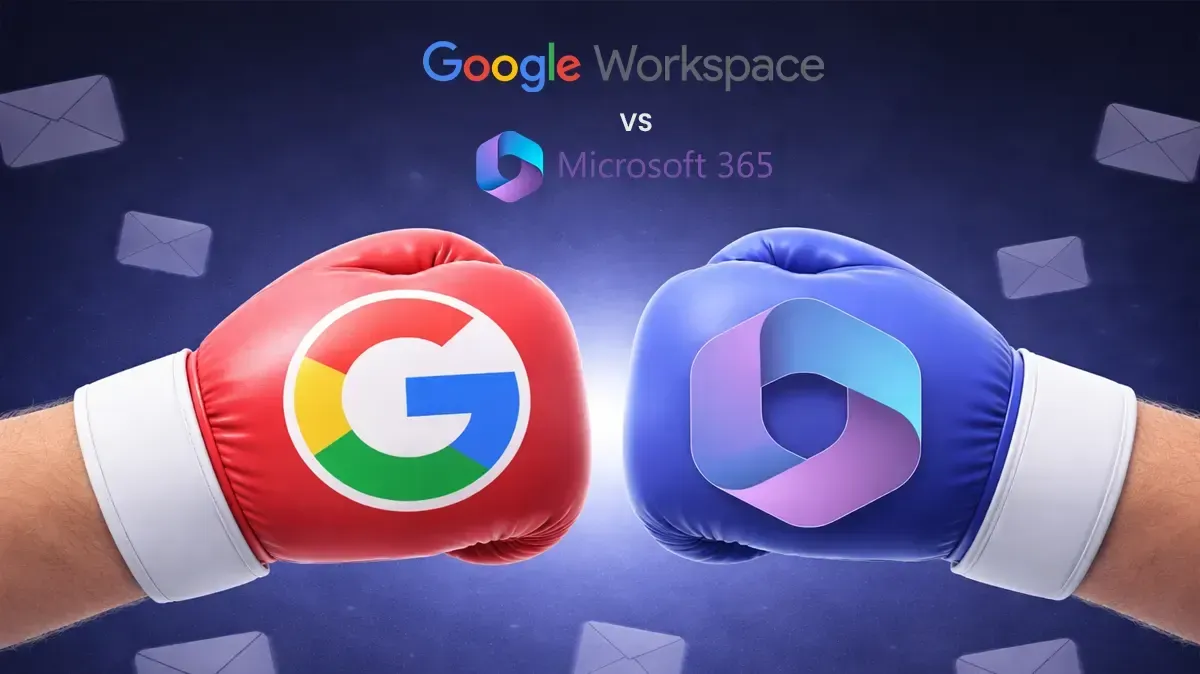
Independent placement tests run on isolated warmup show a consistent home-court advantage. Same-provider matching is the single biggest variable that moves the needle once authentication is set up correctly.
| Destination | Google Workspace sender | Microsoft 365 sender |
|---|---|---|
| Gmail inbox | 85 to 92 percent | 78 to 85 percent |
| Outlook inbox | 75 to 82 percent | 82 to 90 percent |
| Yahoo and AOL | 80 to 88 percent | 76 to 84 percent |
| Overall (mixed B2B) | 94.18 percent | 95.38 percent |
The overall numbers from Primeforge's inbox placement test favor Microsoft by about a point, but the breakdown by destination is what actually drives campaign results. If 65 percent of your prospects are on Gmail, the Google Workspace sender will outperform Microsoft on the volume that matters.
This is why ESP matching (routing each lead to a sender on the same provider) is a feature in serious cold email tools. Without it, you are leaving 5 to 10 percentage points of placement on the table.
Sending limits and what is actually safe
The headline limits are misleading. Google Workspace advertises 2,000 emails per user per day. Microsoft 365 allows 10,000 per user per day but throttles at 30 emails per minute. Neither number is relevant to cold email.
For cold outreach the safe rate is 30 to 50 sends per mailbox per day, on both platforms. Push past that on a young mailbox and the reputation drop is steep, with Microsoft now bouncing high-volume senders that fail SPF, DKIM, and DMARC checks under its May 2025 policy and Google requiring spam complaint rates to stay below 0.10 percent (warning issued at 0.30 percent).
Scaling beyond a few hundred sends per day means more mailboxes, not more volume per mailbox. The pattern most teams settle on is four to six mailboxes per outreach domain, spread across two or three domains. That setup lets you push 1,000 to 1,500 high-quality sends per day without tripping any single mailbox into the spam folder, and it ringfences the rest of your infrastructure if one mailbox does get flagged.
Domain reputation and authentication

Is Microsoft 365 more secure than Google Workspace for cold email? Microsoft gives you more knobs to turn. Whether that translates to better security depends on whether your team will actually configure them.
How Google Workspace handles it
Google runs everything through a shared infrastructure with its own reputation signals layered on top. SPF, DKIM, and DMARC setup is a single TXT record per protocol, exposed through the Admin Console and Google Domains. Monitoring lives in Postmaster Tools, which shows spam rate, authentication pass rate, and how Gmail's reputation engine grades your domain.
Google's gatekeeping is opinionated. The 0.10 percent spam complaint threshold is enforced quietly through inbox placement decay long before you ever see a hard suspension. For more on how those signals stack up, see our breakdown of email sender reputation.
How Microsoft 365 handles it
Microsoft 365 routes mail through Exchange Online Protection, which gives admins more granular control over connectors, transport rules, and tenant-level reputation isolation. DKIM setup requires two CNAME records rather than a single TXT, which is a small but persistent setup hurdle for less technical teams.
Microsoft's tenant isolation is the underrated win. If another customer on the same Microsoft infrastructure burns their reputation, it does not bleed into yours the way shared Google reputation occasionally can. For senders pushing over 5,000 emails per day, Microsoft now mandates working unsubscribe links and full alignment on SPF, DKIM, and DMARC, in line with the Outlook bulk sender requirements that took effect in May 2025.
Both providers will reject the campaign if your authentication is wrong. Our walkthrough of SPF, DKIM, and DMARC for marketers covers the exact records to publish for either platform.
Warmup time and onboarding friction
A new Google Workspace mailbox needs roughly 14 to 16 days of isolated warmup before it is safe to send cold campaigns from. A new Microsoft 365 mailbox needs 17 to 21 days. The gap is small but real, and it compounds when you are spinning up 20 mailboxes for a new client.
Google warms faster because Gmail's reputation engine trusts Google-authenticated senders more quickly. Microsoft is more conservative, which protects you long-term but adds three to five days of zero-volume time before each new mailbox earns its keep. Either way, skipping warmup is the fastest path to landing in spam. Our email warm-up flow lays out the daily ramp curve that keeps both providers comfortable.
Onboarding friction matters past warmup, too. Google Workspace setup is a few clicks plus a DNS change. Microsoft 365 setup involves Entra ID provisioning, license assignment, and DNS records that have slightly less forgiving propagation behavior. For a one-person sales operation, that is two hours of difference. For an agency spinning up infrastructure for ten clients per month, it adds up.
Pricing and what 10 mailboxes really cost
List prices look close. What ten outreach mailboxes actually cost over a year depends on which tier you actually need, not just the entry-level number.
| Plan tier | Google Workspace | Microsoft 365 | Best for |
|---|---|---|---|
| Entry | Business Starter $6 to $7 per user per month | Business Basic $6 per user per month (web only) | Solo or two-person outbound |
| Standard | Business Standard $14 per user per month | Business Standard $12.50 per user per month | Most cold email teams |
| Premium | Business Plus $22 per user per month | Business Premium $22 per user per month | Teams needing advanced security |
| Enterprise | Custom pricing | E3 $33.75, E5 $54.75 per user per month | Compliance-heavy verticals |
A ten-person outreach team on Business Standard runs about $1,680 per year on Google Workspace and $1,500 on Microsoft 365. The $180 gap is small, and Google's slightly higher sending limit per mailbox can cut the number of mailboxes you actually need to maintain, which usually washes out the price difference.
The real disadvantage of Google Workspace for cold outreach shows up at scale: every mailbox is a paid seat. Running 50 mailboxes across five domains means 50 Workspace licenses. Microsoft pricing follows the same shape, which is why agencies running heavy volume often look at dedicated cold email infrastructure once they cross the 30 to 50 mailbox mark.
Running both: the 70 to 30 framework
Provider concentration is risk. If Google tightens enforcement and 100 percent of your mailboxes are Workspace, you have nowhere to fail over to. The fix is to run both providers from day one, weighted by audience.
| Audience profile | Recommended split | Why |
|---|---|---|
| Mostly Gmail (SaaS, tech, startups) | 80% Google, 20% Microsoft | Maximize Gmail placement, keep Outlook coverage alive |
| Mixed B2B | 70% Google, 30% Microsoft | Safe default, covers Gmail majority plus Outlook tail |
| Mostly Outlook (enterprise, finance, legal) | 50% Google, 50% Microsoft | Heavy Outlook presence needs equal Microsoft weight |
| Unknown mix | 70% Google, 30% Microsoft | Same as mixed B2B until data tells you otherwise |
The split only works if your sending tool can route each lead to a sender on the matching provider. Most modern cold email platforms support ESP matching out of the box. Without it, the diversification benefit collapses, because a Google Workspace mailbox emailing an Outlook prospect gives back the home-court advantage you were trying to capture.
One more thing: if you have followed the Gmail and Yahoo bulk sender requirements for your Google side, the same authentication hygiene carries over cleanly to Microsoft. The work is not duplicated, just published in two slightly different DNS shapes.
Building cold email infrastructure that scales
The choice between Google Workspace and Microsoft 365 is less binary than it looks on a feature grid. Each platform has a clean inbox placement advantage on its own destination, and both demand the same hygiene to deliver at all. Picking one as your primary, layering the other in for diversity and ESP matching, and verifying every address before you send is the setup that holds up campaign after campaign.
Mailbox quality only carries you so far if the underlying list is rotten. Soft and hard bounces drag down sender reputation faster than any single platform decision can recover from, which is why list verification belongs in the same conversation as platform choice. The teams that run consistent cold email do not pick one provider, set the mailboxes on autopilot, and walk away. They pair the right provider mix with clean lists, gradual warmup, and weekly checks on deliverability fundamentals.
Quick answers
Is Google Workspace good for cold emails?
Yes, with caveats. It works well as a primary provider if you use a separate outreach domain, warm new mailboxes for 14 to 16 days, cap sends at 30 to 50 per mailbox per day, and verify every address before sending. The 2,000-per-day limit Google advertises is not a cold email send rate, it is a transactional ceiling for mature mailboxes.
Is Microsoft 365 more secure than Google Workspace?
Microsoft gives admins more granular control through Exchange Online Protection and tenant isolation, which can translate to better long-term reputation insulation. Google's defaults are more opinionated and easier to live with. For most cold email teams the practical security difference comes down to which platform you will configure correctly.
What are the main disadvantages of Google Workspace for cold email?
The daily cap, manual per-domain DNS setup, shared IP reputation, lack of a built-in warmup feature, and the per-seat pricing model that makes scaling to dozens of mailboxes expensive. None of these are deal breakers, but they add up if you are running heavy volume.
Should I use Google Workspace or Microsoft 365 if my audience is mixed B2B?
Use both. A 70 percent Google and 30 percent Microsoft split is the safe default. Pair it with a sending tool that can match each lead to a sender on the same provider as the destination address, and you keep the placement advantage on both sides.
§ Before your next send
Find the addresses that will bounce
Verify a single address free, or upload a CSV — the free plan includes 50 checks a month, no card needed.

BounceCheck Team
The team behind BounceCheck - helping businesses verify emails and improve deliverability.